
Table of Contents
- What Does the Custom Exhibit Design Process Look Like?
- How Do Materials and Technology Shape Custom Exhibit Design?
- Can a Custom Exhibit Scale Across Different Booth Sizes?
- What Timeline Should You Plan for a Custom Exhibit Build?
- How Do You Choose the Right Custom Exhibit Partner?
- How Do You Justify the Investment in a Custom Exhibit?
- Frequently Asked Questions
According to EXHIBITOR Magazine, 64% of exhibitors now prefer a single-source partner who handles design, fabrication, and logistics under one roof. That preference reflects a hard-won lesson: custom trade show exhibit design is a multi-phase process where disconnected vendors create delays, cost overruns, and diluted brand impact.
This guide walks marketing directors through every stage of the custom exhibit journey, from discovery through fabrication, logistics, and installation, so you can invest with clarity and arrive on the show floor with an exhibit that performs.
What Makes a Custom Trade Show Exhibit Different?
A custom trade show exhibit is a purpose-built environment designed exclusively around your brand story, audience, and business objectives. Unlike modular or rental systems that adapt pre-engineered components, a custom exhibit starts from a blank canvas, giving you complete control over form, materials, technology integration, and visitor flow.
Research from the Center for Exhibition Industry Research (CEIR) confirms that 81% of trade show attendees carry buying authority, meaning your exhibit must communicate credibility within seconds. When every exhibitor has access to the same modular frames and rental furniture, standing out depends on creating an environment that only belongs to your brand. As we discuss in our Booth Design Blueprint for Engagement, strategic design principles are the foundation of every exhibit that converts attention into outcomes.
For brands investing seriously in trade show marketing, custom environments allow:
- Complete control over visitor flow
- Integrated technology experiences
- Branded architectural elements
- Scalable multi-show design strategy
- Long-term cost efficiency
This is not just exhibit design. It is brand engineering in physical space.
Custom vs. Modular vs. Rental: A Quick Comparison
| Factor | Custom | Modular | Rental |
|---|---|---|---|
| Brand Uniqueness | Complete | Moderate | Limited |
| Design Freedom | Unlimited | Framework-dependent | Catalog-based |
| Upfront Investment | $100K–$250K+ (20x20) | $40K–$100K | $20K–$60K per show |
| Long-Term Cost per Show | Decreases over time | Moderate | Consistent each show |
| Scalability | Engineered in | Built-in | Swap configurations |
| Lead Time | 12–20+ weeks | 8–14 weeks | 4–8 weeks |
There is also a middle path. Hybrid trade show exhibits combine custom-fabricated hero elements with modular infrastructure, delivering high-impact design with greater flexibility. For brands exhibiting at multiple shows per year, this approach often offers the best balance of impact and efficiency.
When deciding between these approaches, our post on selecting the best trade show booth type walks through the evaluation framework in detail.
What Does the Custom Exhibit Design Process Look Like?
The custom exhibit design process follows six core phases:
- Discovery
- Concept Development
- Engineering
- Fabrication
- Logistics
- Installation and Dismantle
Each phase builds on the one before it, and skipping or rushing any stage introduces risk that compounds downstream.
Phase 1: Discovery and Strategy
Every successful custom exhibit begins with deep listening. Your exhibit partner should
- Conduct stakeholder interviews
- Review past show data
- Clarify measurable objectives
- Define audience engagement goals
Discovery typically takes one to two weeks and results in a creative brief that becomes the North Star for everything that follows.
Phase 2: Concept Development
Designers translate the creative brief into spatial experience.
This includes:
- 3D renderings
- Traffic flow planning
- Brand storytelling hierarchy
- Demo and meeting placement
- Technology integration
At this stage, exhibit builders should think beyond structure and focus on behavioral design. Our guide on trade show graphics that stop traffic details how visual hierarchy and messaging placement can make or break the crucial first three seconds of an attendee's attention.
Phase 3: Engineering and Structural Design
Approved concepts move into structural engineering.
Engineers:
- Specify materials
- Calculate load requirements
- Ensure venue compliance
- Prepare build-ready documentation
This is where in-house fabrication capabilities become a decisive advantage: when your designer and your engineer work in the same building, iterations happen in hours instead of days.
Our post on how in-house fabrication transforms trade show design explains why this integration matters and how advanced tools like 6-axis CNC machining enable precision and speed that outsourced fabrication cannot match.
Phase 4: Fabrication
With engineering approved, fabrication begins. This phase includes:
- CNC cutting
- Welding and metalwork
- Woodworking
- Finishing and painting
- Graphic production
- Technology integration
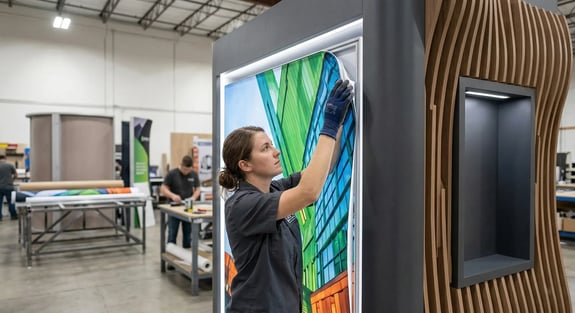
A fully in-house shop allows for real-time quality control; when something needs adjustment, your team walks to the shop floor rather than emailing a third-party vendor.
"We built our entire operation around the idea that the people who design your exhibit should be able to walk into the shop and watch it being built. That proximity eliminates the translation errors that plague multi-vendor projects and lets us iterate faster than anyone in the industry."
— The team at Exhibit Options
Phase 5: Logistics and Shipping
Logistics is often where poorly managed projects unravel.
Custom trade show exhibits require:
- Specialized crating
- Freight coordination
- Advance warehouse planning
- Drayage management
- Union labor coordination
We unpack the full picture in From Vision to Victory: The Unseen Logistics of Successful Experiential Trade Show Exhibits and cover broader planning in Mastering Trade Show Logistics.
Phase 6: Installation, Show Support, and Dismantle
Installation and dismantle crews execute according to detailed documentation. Experienced I&D crews:
- Assemble structure
- Test lighting and LED content
- Validate technology integration
- Conduct final walkthrough
Post-show dismantle and return shipping complete the cycle. A single-source in-house partner manages every step, ensuring accountability from first sketch to final crate.
How Do Materials and Technology Shape Custom Exhibit Design?
Material and technology choices define the sensory identity of your exhibit. They determine how your brand feels to the touch, how it catches light, how it sounds as visitors move through the space, and how effectively it communicates your value proposition. The right selections elevate a custom exhibit from a structure into a brand experience.
Material Trends Driving Modern Exhibit Design
SEG (silicone-edge graphics) fabric now appears in over 70% of new custom builds, according to EXHIBITOR Magazine. SEG systems offer seamless, high-resolution graphics that are lightweight, easily updatable, and backlit-compatible. They have largely replaced traditional rigid graphics in custom exhibit design.
Beyond graphics, material selection spans structural substrates (aluminum, steel, wood, composites), surface finishes (laminates, veneers, powder coat), and flooring (raised platforms, branded carpet, hardwood). Each material communicates something about your brand. As we explore in From Seen to Felt: The Unspoken Language of Materials in Exhibit Design, a raw concrete texture signals innovation while high-gloss finishes communicate precision and luxury.
For a deeper dive into how textures and finishes contribute to the attendee experience, see our complementary post on choosing finishes and textures that enhance your trade show booth experience.
Technology Integration
LED content displays attract 4x more initial attention than static graphics, making them a cornerstone of modern custom exhibits. But technology extends beyond screens: interactive touchscreens, product configurators, beacon and NFC systems, augmented reality overlays, and integrated audio zones all contribute to a richer environment.
The key is purposeful integration. Every technology element should serve a specific engagement or data-capture objective. Our guide to beacon, NFC, and QR technology for trade shows outlines how to layer these tools for maximum effectiveness without overwhelming the visitor.
Can a Custom Exhibit Scale Across Different Booth Sizes?
Yes, and it should. A well-engineered custom exhibit is designed from the outset to scale across multiple footprints, from a 10x10 inline to a 20x20 island to a 40x40 anchor presence, using a shared library of modular custom components. This scalability protects your investment and ensures brand consistency across every event on your calendar.
However, scalability is not automatic. As we detail in The Scalability Trap, a design optimized for one footprint does not simply expand without significant rethinking. 73% of new custom designs prioritize open floor plans with multiple entry points (EXHIBITOR Magazine), precisely because open layouts scale more gracefully than walled, corridor-based designs.
Designing for Scalability from Day One
The most cost-effective approach is to plan scalability during the discovery phase. Identify which elements are essential at every size (hero brand moment, primary demo station, meeting space) and which are additive (secondary activations, lounge areas, expanded storage). Your exhibit partner should deliver a configuration matrix that maps components to booth sizes, ensuring seamless adaptation from show to show.
What Timeline Should You Plan for a Custom Exhibit Build?
Plan a minimum of 12 to 16 weeks for a custom exhibit build, according to the Experiential Designers and Producers Association (EDPA). However, 20 or more weeks is the ideal timeline for complex builds involving technology integration, multiple scalable configurations, or first-time partnerships where the discovery phase requires greater depth.
| Phase | Duration (Typical) | Duration (Complex) |
|---|---|---|
| Discovery & Strategy | 1–2 weeks | 2–3 weeks |
| Concept Development | 2–3 weeks | 3–4 weeks |
| Engineering & Structural Design | 2–3 weeks | 3–4 weeks |
| Fabrication | 4–6 weeks | 6–8 weeks |
| Graphics Production | 1–2 weeks (parallel) | 2–3 weeks (parallel) |
| Logistics & Shipping | 1–2 weeks | 2–3 weeks |
| I&D (On-Site) | 2–4 days | 3–5 days |
Rushed timelines are one of the most reliable predictors of cost overruns and compromised quality. Every week cut from the front end of the schedule creates exponentially more pressure on fabrication and logistics. For a comprehensive planning framework, see our trade show planning timeline.
Budget planning should parallel timeline planning. Our first-time exhibitor budget checklist and guide to mastering trade show costs identify the hidden expenses that catch exhibitors off guard, from drayage and electrical to last-minute graphic reprints.
How Do You Choose the Right Custom Exhibit Partner?
Evaluate a custom exhibit partner based on four criteria:
- In-house fabrication capabilities
- Strategic portfolio strength
- Transparent communication processes
- Proven scalability expertise
The cheapest bid is rarely the best value, and the fanciest portfolio means little without operational reliability.
Why In-House Fabrication Matters
81% of exhibitors cite access to specialized talent as the top advantage of outsourcing exhibit design and fabrication (EXHIBITOR Magazine). But outsourcing to an in-house fabrication partner is fundamentally different from outsourcing to a designer who subcontracts fabrication. The former gives you one accountable team; the latter introduces risk at every handoff.
An in-house exhibit partner controls the full chain:
- Creative
- Engineering
- Fabrication
- Graphics
- Logistics
- Installation
When a design change arises mid-fabrication, the designer walks to the shop floor and solves it with the fabricator in real time. This is exactly how Exhibit Options operates from our facilities in Las Vegas and Cerritos, California.
Questions to Ask Potential Partners
- Do you fabricate in-house or subcontract? What percentage is done under your roof?
- Can I tour your fabrication facility?
- How do you handle mid-project design changes?
- What is your approach to scalability across multiple booth sizes?
- Who is my single point of contact throughout the project?
- Can you share references from brands at similar show sizes?
- Do you manage I&D with your own crews or subcontractors?
"The exhibit industry has a dirty secret: many companies that present themselves as full-service partners are actually project managers who outsource every phase. That model works until something goes wrong, and on a trade show timeline, something always goes wrong. In-house control is how you protect your investment and your deadline."
— The team at Exhibit Options
How Do You Justify the Investment in a Custom Exhibit?
Justify a custom exhibit investment by calculating cost-per-show over a three-to-five-year lifecycle, comparing it against the cumulative cost of rentals, and layering in the qualitative advantages of brand differentiation, attendee experience quality, and competitive positioning that rental and modular systems cannot replicate.
The Lifecycle Cost Advantage
A custom 20x20 exhibit at $100K-$250K+ (EXHIBITOR Magazine) sounds steep compared to a $30K-$60K rental. But custom exhibits are used for three to five years across multiple shows. Exhibit four times per year over four years, and your per-show cost drops to $6,250-$15,625, often undercutting rental costs. For a rental-versus-ownership analysis, review Debunking "Buy Once, Cry Once".
The Performance Premium
Custom exhibits outperform standardized options on every meaningful metric: dwell time, lead quality, social amplification, and post-show brand recall. According to Event Marketer, 85% of consumers are more likely to purchase after participating in a brand experience, an advantage that custom environments maximize by design. They also communicate market leadership. When your exhibit is clearly purpose-built, attendees perceive your brand as more invested, more established, and more worth their time. That perception directly influences return on experience (ROX).
For brands weighing whether to invest in custom design, our post on three critical mistakes that kill trade show ROI illustrates the hidden costs of underinvesting in your trade show presence, often exceeding the savings from choosing a cheaper booth option.
Frequently Asked Questions
How much does a custom trade show exhibit cost?
A custom 20x20 exhibit typically ranges from $100,000 to $250,000 or more for design and fabrication, according to EXHIBITOR Magazine. Smaller footprints can range from $30,000 to $80,000, depending on complexity. The per-show cost decreases significantly over a multi-year lifecycle, often making custom more cost-effective than repeated rentals.
How long does it take to build a custom trade show exhibit?
Plan for a minimum of 12 to 16 weeks from discovery through delivery, with 20 or more weeks recommended for complex builds. Rushing the timeline increases costs and compromises quality. Starting discovery five to six months before your show date gives your partner the runway to deliver exceptional results.
What is the advantage of an in-house exhibit fabrication partner?
An in-house fabrication partner controls design, engineering, fabrication, graphics, and logistics under one roof. This eliminates translation errors and communication delays that occur when work is subcontracted across multiple vendors. The result is tighter quality control, shorter timelines, and a single point of accountability.
Can a custom exhibit be reconfigured for different booth sizes?
Yes, when scalability is engineered from the start. A well-designed custom exhibit uses shared modular components that assemble into different configurations for various footprints. The key is planning for this during discovery rather than adapting a single-size design after fabrication. Read more in our scalability guide.
Should I choose custom, modular, or rental for my trade show exhibit?
The best choice depends on show frequency, budget horizon, and brand objectives. If you exhibit three or more times per year, custom delivers the best long-term value. For occasional exhibitors, modular or hybrid solutions may be ideal, and rental works well for one-off events. Our detailed comparison guide helps you evaluate each option.
Build the Exhibit Your Brand Deserves
Custom trade show exhibit design is not simply about building a booth. It is about engineering a brand environment that commands attention, facilitates meaningful connections, and delivers measurable business outcomes across every show on your calendar. Every phase of the process shapes the experience your attendees will have and the results your leadership team will see.
The brands that invest in custom exhibits with a strategic, single-source partner consistently outperform those that piece together vendor relationships show by show. With in-house design, engineering, and fabrication capabilities, including 6-axis CNC machining, plus full logistics and I&D management, Exhibit Options has delivered that advantage to brands since 2005. As a veteran-owned and woman-owned agency operating from Las Vegas and the greater Los Angeles area, we bring both the craft and the strategic depth to make your next exhibit the strongest asset in your marketing portfolio.
Ready to start the conversation? Contact Exhibit Options to schedule a complimentary discovery session. Let us show you what is possible when design, fabrication, and strategy work under one roof.

COMMENTS