
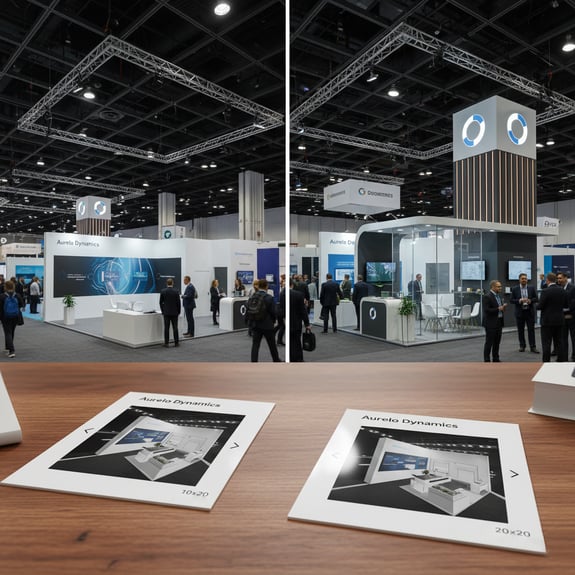
Most exhibitors assume that moving from a 10x20 to a 20x20 is a simple upgrade. Double the space, double the impact. In reality, this is one of the most costly misconceptions in trade show marketing. A booth that succeeds in a 10x20 footprint does not automatically translate into an impactful 20x20. Without a strategic redesign, the larger footprint often performs worse, creating empty space, unclear flow, and weaker engagement.
From layout and attendee flow to sightlines, focal points, and engagement strategy, scaling up requires more than stretching out your existing assets. It requires a complete shift in how your space communicates, attracts, and converts.
Below, we break down why scaling up fails, what exhibitors overlook, and how intentional modular design protects your event ROI.
Why 10x20 Success Does Not Scale to 20x20
1. A Great 10x20 Is Built for Controlled Flow
A 10x20 forces clarity. Messages are concise. Traffic patterns are obvious. The focal point is intentional.
Most exhibitors assume that moving from a 10x20 to a 20x20 is a simple upgrade. Double the space, double the impact. But in reality, a booth that is highly effective in a 10x20 footprint rarely performs the same way when scaled up. The spatial dynamics, sightlines, and engagement expectations shift significantly, and without a strategic redesign, the larger space often performs worse.
2. A 20x20 Needs Vertical Presence, Not Just More Space
A larger footprint increases visual competition. You are no longer competing only with the booths to your left and right. You are competing with islands, hanging signs, overhead architecture, lighting truss, and multi-sided storytelling.
A repurposed 10x20 design often sits too low and too flat. Without height, multi-directional branding, and layered storytelling, the booth disappears among more dynamic exhibits.
3. Messaging That Works in a Smaller Space Is Often Too Thin for a 20x20
Smaller booths thrive on sharp, minimal messaging.
Larger booths require differentiated zones, each with a purpose. If the only message is a single headline stretched across a larger structure, the booth feels unfocused.
Visitors walk in expecting more depth. If the experience does not evolve as they explore, your exhibit loses stopping power.
4. Engagement Needs Shift When the Footprint Expands
In a 10x20, the team usually stands at the edge, ready to welcome.
In a 20x20, attendees expect guided conversations, demo zones, casual meeting areas, or interactive elements.
A scaled-up space without these touchpoints becomes a pass-through instead of an experience.
5. Replicating Your Existing Structure Often Creates Budget Waste
Many exhibitors decide to scale up because they have the budget. But without rethinking modularity and long-term ROI, they end up with a design that is expensive to ship, store, update, or reconfigure for future shows.
Strategic scaling is less about size and more about design intention, traffic behavior, and long-term value.
The Strategic Shift Required When Scaling Up
To scale your footprint effectively, you need a fundamental redesign, not a bigger version of the same booth.
1. Reimagine Attendee Flow for Multi-Directional Traffic
A 20x20 should allow attendees to enter from multiple sides.
This requires designing a layout that guides movement naturally, with intentional discovery moments at each angle.
2. Establish New Focal Points
A successful larger footprint uses layered focal points:
- Primary: overhead signage or tall architecture
- Secondary: hero product or storytelling wall
- Tertiary: demo stations, touchscreens, or content zones
These focal points create paths that draw traffic deeper into the space.
3. Build Scalable Messaging Hierarchies
Instead of a single headline, a 20x20 benefits from:
- A main brand pillar
- Sub messages or product highlights
- Content elements that evolve as visitors move around the booth
This creates dimension and clarity.
4. Add Engagement Zones
As footprints grow, so should the ways attendees interact. Consider:
- 1 to 2 demo stations
- A small meeting area
- A hospitality touchpoint
- A digital interaction element or showcase
Engagement zones transform the booth from a display into an experience.
5. Use Modular Design to Increase Long-Term ROI
An innovative event marketing agency or experiential marketing agency designs for:
- Multiple booth sizes
- Multi-city show schedules
- Long-term budget efficiency
- Future brand updates
Modularity ensures your investment works harder across your trade show marketing calendar.
When Bigger Is Worth It
Scaling up your booth can deliver significant ROI when it is done correctly. A larger footprint increases brand presence, meeting capacity, visibility, and experiential engagement opportunities.
But going bigger on its own is not enough. Bigger only works when the design strategy evolves with the space. A 20x20 should feel:
A 20x20 should feel:
- Intentional
- Layered
- Dynamic
- Purpose built
- Experiential
If it feels like a stretched 10x20, the footprint is not serving you.
Why Exhibitors Choose Exhibit Options for Scalable Design
At Exhibit Options, our experiential design and exhibit builders team specializes in building forward-thinking modular systems that scale intelligently. Our approach ensures that every booth size performs at its best, whether it is a 10x20, 20x20, or beyond.
We combine:
- Data-informed attendee behavior insights
- High-impact experiential marketing
- Flexible modular architecture
- Strategic storytelling
- Seamless fabrication and logistics support
Scaling up is a design challenge. Our team solves that challenge through expertise, creativity, and a deep understanding of how booth footprints should evolve.
Ready to scale your next booth the right way?
Our team will help you build a strategy that aligns with your brand, budget, and long-term goals.
Start planning your scalable exhibit today —> Contact the Exhibit Options team.

COMMENTS