
Trade show experiences succeed or fail long before an attendee steps onto the show floor. Beneath every clean sightline, seamless interaction, and confident brand moment is a physical structure that must perform under real-world conditions. Tight timelines. Repeated installs. Union labor rules. Long show days. Freight constraints. None of these challenges appear in a rendering, but all of them determine whether an exhibit actually works.
Experiential design is often discussed as a creative discipline. In practice, it is just as much an engineering challenge.
Materials must withstand repeated use. Structures must assemble efficiently. Graphics must align precisely. And every component must function flawlessly in crowded halls with no margin for error. This is where in-house fabrication fundamentally changes outcomes.
At Exhibit Options, engineering and fabrication are not execution steps that happen after design approval. They are embedded into how experiences are conceived, refined, and built from the very beginning.
Why Engineering Shapes the Experience Itself
A trade show exhibit is not a static object. It is a working environment. Staff move through it. Attendees flow in and out. Conversations happen in tight spaces. Technology, lighting, and power must integrate seamlessly.
Engineering determines how that environment behaves.
When engineering is treated as an afterthought, exhibits often look impressive but struggle in execution. Structures feel cramped. Storage is inadequate. Installation takes longer than expected. Components wear down prematurely. These issues create friction that affects both staff performance and attendee experience.
By integrating engineering early, Exhibit Options designs environments that account for real-world use. Visitor flow, structural integrity, durability, and installation efficiency are addressed from the start, ensuring the experience performs as intended show after show.
What “In-House Fabrication” Actually Delivers
In the exhibit industry, “in-house” is often used to refer to project management rather than production. At Exhibit Options, in-house fabrication is literal.
Design, engineering, fabrication, finishing, and graphics production are all handled internally by EO teams within EO facilities. Critical steps are not outsourced, and quality control remains consistent throughout the process.
This structure eliminates common points of failure. There are fewer handoffs, fewer interpretation gaps, and fewer last-minute adjustments. When design and fabrication teams work side by side, decisions are made faster and with full awareness of how each choice impacts the final build.
For marketing and event teams, this means predictability. The exhibit that arrives on the show floor behaves as intended.
Facilities Designed for Complex Builds
Exhibit Options operates full-service fabrication facilities in Southern California and Las Vegas, providing direct access to two of the country's largest trade show markets.
Each location supports the full scope of experiential fabrication, from custom trade show exhibits to branded environments and corporate interiors. This coast-to-coast presence reduces shipping complexity, shortens lead times, and creates flexibility when schedules shift.
For brands managing multi-show programs or large-scale environments, this infrastructure ensures consistency across builds while allowing teams to respond quickly to changing needs.
CNC, Fabrication, and Shop Capabilities
Engineering precision requires the right tools.
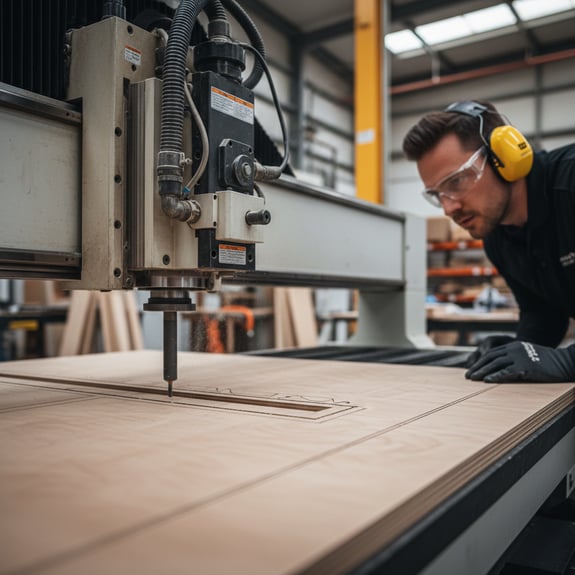
Exhibit Options fabrication shops are equipped with advanced machinery designed to execute complex builds accurately and efficiently. Multicam CNC tool changers, routers, laser cutters, and panel saws enable teams to produce custom components with exacting detail and repeatable accuracy. Full wood, metal, and paint shops support a wide range of materials and finishes, from structural frameworks to refined architectural elements.
These capabilities enable EO to control tolerances, ensure structural integrity, and maintain finish quality across all components. Custom elements are not adapted to fit limitations. They are engineered to meet environmental demands.
Design and Engineering Working as a Single System
On the design and engineering side, the Exhibit Options teams use advanced CAD, 3D modeling, and rendering software to develop detailed construction drawings and photorealistic visuals. These tools help identify and resolve potential challenges well before fabrication begins.
Structural loads, assembly sequencing, and installation logistics are reviewed early in the process. This proactive approach reduces rework, minimizes on-site surprises, and ensures that creative concepts translate cleanly into physical builds.
When design and engineering operate as a single system, fabrication becomes more efficient, and execution becomes far more reliable.
In-House Graphics That Align With the Build
Graphics play a critical role in how an environment communicates, but they also introduce risk when handled separately.
Exhibit Options maintains in-house graphics production, including large-format printing, vinyl cutting, and finishing. By producing graphics alongside fabrication, EO ensures precise alignment, accurate color matching, and material compatibility across all surfaces.
This integration reduces installation issues and ensures branding supports the structure rather than fighting against it. Messaging remains clear. Wayfinding remains intuitive. And the final environment feels cohesive rather than layered.
Engineering Beyond the Trade Show Floor
The same engineering and fabrication capabilities that support trade show exhibits also extend into corporate interiors and permanent branded environments. Reception areas, conference rooms, collaboration spaces, and custom furniture pieces are built with the same attention to structure, flow, and longevity.
These environments must perform daily, not just during an event. Engineering ensures they remain functional, durable, and aligned with brand expression over time.
Why Engineered Experiences Perform Better
When engineering, design, and fabrication are fully integrated, performance improves across every stage of execution. Builds move faster. Installation becomes more predictable. Wear and tear is reduced. And environments maintain their integrity across multiple uses.
For organizations investing in trade show marketing, this integration provides confidence. Teams know their environments will assemble efficiently, function properly, and represent their brand accurately under real-world conditions.
This is the difference between assembling exhibits and engineering experiences.
Turning Craft Into Confidence
Trade show exhibits and branded environments carry significant expectations. They must attract attention, support engagement, and withstand demanding conditions.
By keeping engineering and fabrication in-house, Exhibit Options delivers environments that are not only visually compelling but structurally sound and operationally reliable. The result is confidence. Confidence in execution. Confidence in performance. Confidence that the experience will deliver what it was designed to do.
In an industry where small details have large consequences, engineered experiences are not optional. They are essential.
To learn how in-house engineering and fabrication can support your next trade show exhibit or branded environment, connect with Exhibit Options to start a focused, goal-driven conversation.

COMMENTS