
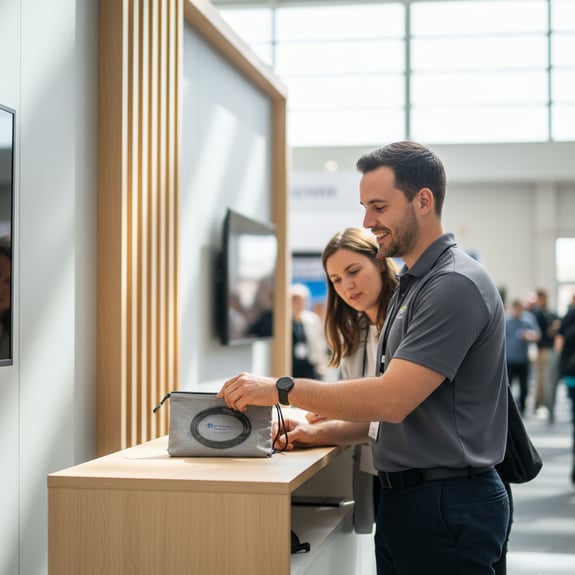
Trade show giveaways are often the largest line item in an event budget and among the least strategic. Items are ordered, logos are printed, and swag is distributed on the assumption that visibility alone creates value.
In practice, most giveaways deliver little return. They are quickly discarded, rarely remembered, and disconnected from the broader brand experience. For marketing and event managers under pressure to prove ROI, that gap matters.
The issue is not the giveaways themselves. It is how they are chosen.
When swag is treated as an afterthought, it becomes clutter. When selected intentionally, it becomes a physical extension of the brand story, reinforcing key messages and extending the experience's impact beyond the show floor.
As trade show marketing evolves, leading exhibitors now evaluate giveaways through the same strategic lens as exhibit design and experiential engagement. The goal is no longer to give something away. It is to give attendees something worth keeping.
Why Most Trade Show Swag Fails
Walk any trade show floor, and you will see the same pattern repeated booth after booth. Bowls of low-cost trinkets, novelty items, and generic promotional pieces are offered to anyone who walks by.
The issue is not generosity. It is relevance.
Most attendees are moving quickly, scanning dozens of brands in a single day. Items that feel cheap, impractical, or disconnected from the brand message do not register as value. They create momentary interaction, but no lasting impression. In many cases, they actively dilute brand perception by signaling that little thought went into the experience.
From a budget perspective, this type of swag often delivers the worst possible outcome: high unit counts, low engagement quality, and zero post-show impact.
So what separates giveaways that work from those that waste money?
The Strategic Shift: From Free Items to Brand Artifacts
High-performing exhibitors approach giveaways as brand artifacts rather than promotional clutter. Each item serves a purpose beyond visibility. It reflects the brand’s values, supports the booth narrative, and earns its place in the attendee’s daily life.
Useful, high-quality items such as drinkware, tech accessories, or thoughtfully designed tools tend to outperform novelty giveaways for a simple reason: they get used. Every use becomes a subtle reminder of the brand and the experience associated with it.
More importantly, these items feel intentional. They signal confidence, quality, and respect for the attendee’s time and attention. That perception carries far more weight than a logo alone.
For exhibit builders and experiential marketing agencies, this shift aligns naturally with a broader strategy focused on creating experiences rather than distributing merchandise.
A Simple Framework for Choosing Swag That Delivers ROI
When evaluating trade show giveaways, successful brands tend to filter choices through a few strategic questions.
Does It Align With the Brand Story?
Every brand tells a story, whether intentionally or not. The best giveaways reinforce that narrative rather than distract from it.
A sustainability-focused company handing out disposable plastic items creates immediate friction. A technology brand offering outdated or flimsy accessories undermines its own positioning. Conversely, a well-designed item that reflects craftsmanship, innovation, or care strengthens brand credibility.
Swag should feel like it belongs in your exhibit, not like it was pulled from a generic catalog at the last minute.
Is It Genuinely Useful?
Utility is one of the strongest predictors of longevity. Items that solve small, everyday problems stay in circulation. Drinkware that fits car cup holders. Charging cables that live in travel bags. Desk accessories that integrate seamlessly into a workday.
If an item does not clearly answer the question, “When would someone use this?”, it is unlikely to earn a place in an attendee’s routine.
From a trade show marketing perspective, usefulness extends the lifespan of your investment far beyond the event itself.
Does It Support Engagement, Not Just Distribution?
The most effective giveaways often require interaction rather than passive pickup. This could mean tying the item to a conversation, a product demo, a digital activation, or a simple qualification step.
Instead of sitting on a counter, the giveaway becomes a reward for engagement. This approach improves lead quality, slows down booth traffic in a positive way, and creates more meaningful exchanges between staff and attendees.
In experiential marketing, the item is not the experience. It is a tangible reminder of it.
Is Quality Doing the Talking?
Quality communicates faster than any headline. Attendees subconsciously associate the feel and finish of a giveaway with the brand behind it.
High-quality items do not need to be extravagant. They need to feel intentional. Solid materials, clean design, and thoughtful packaging all contribute to perceived value. These details matter because they reflect how seriously a brand takes its presence on the show floor.
For brands investing in custom exhibit design, cheap swag can quietly undermine an otherwise polished environment.
Sustainability and the Modern Attendee
Sustainability is no longer a niche concern. Many attendees actively avoid items they perceive as wasteful, regardless of branding.
Choosing fewer, better giveaways can significantly reduce environmental impact while improving brand perception. Some brands now replace physical swag entirely with experiential alternatives such as digital content, charitable tie-ins, or product access that continues after the show.
This approach aligns naturally with experiential design principles, where value is created through engagement rather than accumulation.
Integrating Swag Into the Overall Exhibit Strategy
The most effective giveaways are never planned in isolation. They are considered alongside exhibit design, visitor flow, messaging, and post-show follow-up.
When an event marketing agency approaches a project holistically, giveaways become another touchpoint within a connected brand ecosystem. They reinforce the same story told through graphics, interactions, staff training, and digital extensions.
This level of integration requires early planning and collaboration, not a rush order weeks before move-in. It is one of the clearest indicators of whether an exhibitor is thinking strategically or tactically.
A Smarter Way Forward
Trade show giveaways still have a place. The difference is how intentionally they are chosen and deployed.
When swag is treated as a strategic asset rather than a line item, it can elevate the entire experience. It can extend brand visibility, reinforce messaging, and create a physical connection that outlasts the event itself.
When it is treated as an obligation, it quietly drains budget and opportunity.
For brands serious about experiential design and measurable trade show performance, the question is no longer how much to give away. It is how thoughtfully.
The goal is not to give something away. It is to give attendees something worth keeping.
If you are rethinking how giveaways fit into your next trade show strategy, an experienced event marketing agency can help align every touchpoint, from exhibit design to engagement planning, into a cohesive experience that drives real results.

COMMENTS