
Table of Contents
-
What Is the Real Difference Between Brand Activation and Experiential Marketing?
- Why Are Brands Moving Beyond the Trade Show Floor?
- What Types of Brand Activations Work Beyond Trade Shows?
- How Do You Plan a Brand Activation From Concept to Execution?
- How Does Trade Show Expertise Transfer to Brand Activations?
- How Do You Amplify a Single Activation Into a Multi-Channel Campaign?
- What Metrics Prove Brand Activation Success?
- Frequently Asked Questions
The global experiential marketing market has surpassed $128 billion, according to Grand View Research, and the fastest-growing segment is not trade shows. It is brand activations: pop-ups, mobile tours, product launches, and festival integrations that meet audiences where they live, shop, and play.
Brand activation experiential marketing extends the design and fabrication expertise behind trade show programs into formats that reach consumers year-round. In this guide, you will learn:
- The real difference between brand activation and experiential marketing
- The most effective activation formats beyond trade shows
- How to plan and execute a scalable activation program
- How to amplify one live experience into a multi-channel growth engine
What Is the Real Difference Between Brand Activation and Experiential Marketing?
Brand activation is a specific campaign designed to drive a defined action, such as a product trial, app download, or purchase, through direct consumer interaction. Experiential marketing is the broader discipline of creating immersive brand experiences that build emotional connection and loyalty. Every brand activation is experiential marketing, but not every experiential campaign is an activation. Understanding this distinction shapes how you set objectives, measure results, and allocate budget.
Brand Activation: Action-Oriented, Campaign-Specific
A brand activation has a clear trigger and a measurable outcome. Examples include
- A pop-up sampling event that generates product trials
- A mobile tour that drives app downloads
- A product launch event creating media coverage and pre-orders.
The defining characteristic is that an activation asks the audience to do something specific. For a deeper exploration, read our full comparison of brand activation vs. experiential marketing at trade shows.
Experiential Marketing: Relationship-Oriented, Long-Term
Experiential marketing prioritizes two-way, immersive interactions over passive advertising. According to EventTrack, 91% of consumers feel more positive about a brand after a live experience, and 85% are more likely to purchase.
Whether the tactic is a trade show exhibit, a pop-up store, or a branded festival space, the strategy is the same: create a memorable, participatory interaction that earns loyalty beyond what advertising alone achieves. Our guide on what experiential marketing is and why it works covers these principles in detail.
Why Are Brands Moving Beyond the Trade Show Floor?
Trade shows remain powerful, but they represent just one venue in a larger experiential ecosystem. Brands are expanding because 78% of Millennials prefer spending on experiences over material goods, according to the Harris Poll. This generational shift, combined with the desire for year-round presence, is driving investment into formats that reach consumers in everyday environments.
The Year-Round Brand Presence Problem
Most trade shows happen once a year, leaving 50-plus weeks where your most powerful channel, live interaction, sits dormant. A mobile tour can visit 20 cities in three months. A pop-up can occupy a high-traffic corridor for a weekend or a season. These formats extend your experiential investment far beyond two or three show days. The team at Exhibit Options frequently helps clients repurpose trade show assets into traveling activations, maximizing fabrication ROI. For strategies on extending impact, explore the digital afterlife of your trade show booth.
Meeting Audiences Where They Already Are
Brand activations intercept consumers in their natural habitats: shopping districts, festivals, sporting events, and transit hubs. EventTrack data shows each attendee shares their experience with an average of 17 people, meaning a well-designed activation creates exponential word-of-mouth. Learn how to build that shareability in our article on creating viral experiences.
What Types of Brand Activations Work Beyond Trade Shows?
The experiential landscape includes dozens of formats, each suited to different objectives and budgets. The most effective programs match the format to the strategic goal rather than choosing a trendy tactic and working backward from it. Below are five impactful formats for brands expanding beyond traditional exhibiting.
1. Pop-Up Brand Experiences
Temporary branded environments located in retail corridors, hospitality venues, or public spaces.
Best for: Product launches, seasonal campaigns, market testing
Strength: Urgency plus total brand control
Design priority: Visual impact and social shareability
Pop-ups are temporary branded environments in retail, hospitality, or public spaces lasting from one day to several months. They are ideal for product launches, seasonal campaigns, and market testing. The temporary nature creates urgency, while the curated environment offers complete brand control. Activations with "Instagrammable" moments generate 2-4x more social impressions according to Event Marketer, and pop-ups are purpose-built for shareable design.
2. Mobile Tours and Experiential Vehicles
Custom vehicles or containerized builds that travel market to market.
Best for: Regional expansion, multi-city education, sampling
Strength: Scalable reach with consistent brand execution
Design priority: Structural durability and modular efficiency
Mobile programs demand advanced engineering. Assets must withstand transport, outdoor exposure, and rapid installation cycles.
3. Product Launch Activations
A dedicated launch activation creates a controlled environment where media, influencers, and priority customers experience a new product in exactly the intended context.
Best for: Major product introductions
Strength: Complete control of narrative and environment
Design priority: Storytelling immersion
Unlike a trade show, you are the sole focus of attention. Storytelling is essential: the entire environment should narrate the product's origin, purpose, and differentiation.
4. Festival and Event Integrations
Music festivals, sporting events, and cultural gatherings attract large audiences already in an experience-seeking mindset.
Best for: Mass awareness and brand alignment
Strength: Access to high-energy, experience-seeking audiences
Design priority: Functional value plus interaction
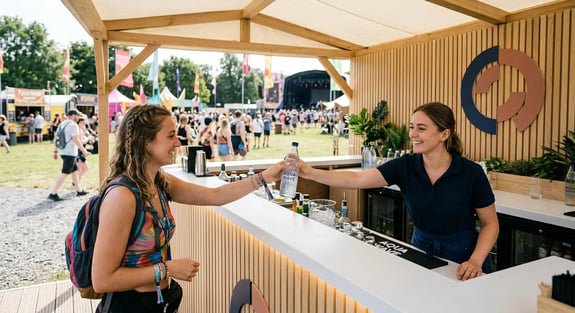
The best festival activations provide genuine value: shade and hydration at an outdoor event, a charging station at a tech conference, or an interactive game at a family festival.
5. Permanent Brand Experience Centers
For brands with the budget and commitment, a permanent experience center serves as a showroom, education center, event venue, and brand temple.
Best for: Flagship presence and ongoing client engagement
Strength: Long-term brand immersion
Design priority: Architectural durability and experiential depth
These spaces often exceed trade show fabrication standards due to continuous use requirements.
| Activation Format | Best For | Typical Duration | Audience Type |
|---|---|---|---|
| Pop-Up Experience | Product launch, seasonal campaigns, market testing | 1 day to 6 months | B2C / B2B2C |
| Mobile Tour | Multi-market reach, regional launches, education | 2-6 months (touring) | B2C / B2B |
| Product Launch Activation | Media/influencer events, VIP reveals | 1-3 days | Media / VIP / B2B |
| Festival / Event Integration | Mass awareness, audience alignment, sampling | 1-4 days (per event) | B2C |
| Brand Experience Center | Flagship presence, client entertainment, ongoing events | Permanent | B2B / B2C |
How Do You Plan a Brand Activation From Concept to Execution?
Planning a brand activation follows many of the same principles as planning a trade show exhibit, but adds variables around venue selection, permitting, and audience acquisition. A structured six-phase process ensures creative ambition stays grounded in operational reality.
Phase 1-3: Strategy, Creative, and Design Development
Phase one defines strategic objectives: what action do you want the audience to take?
Phase two translates strategy into a creative concept with narrative, look, and emotional tone.
Phase three produces detailed design development with 3D renderings and spatial layouts.
Activation venues are far more variable than convention centers, so a pop-up in a retail corridor has different structural and permitting requirements than a mobile tour stop in a city park. Logistics planning is critical at this stage.
Phase 4-6: Fabrication, Execution, and Measurement
Phase four is fabrication. In-house capabilities, such as those at Exhibit Options' Las Vegas and Cerritos facilities, offer faster iteration, tighter quality control, and the ability to prototype before shipping.
Phase five is on-site execution: installation, staffing, and real-time management.
Phase six is post-activation measurement. A solid planning timeline adapted for activations typically requires 12-16 weeks for medium-scale programs.
How Does Trade Show Expertise Transfer to Brand Activations?
The core competencies are identical:
- Spatial storytelling
- Precision fabrication
- Modular engineering
- Logistics management
- Audience flow design
In many cases, activation demands are even more rigorous because there is no show organizer managing venue infrastructure.
Fabrication Quality and Structural Engineering
Trade show exhibits must be modular, durable, shippable, and installable within tight windows. Activations share these requirements and often involve exposure to outdoor weather, varied terrain, and heightened public safety scrutiny. The in-house fabrication capabilities at Exhibit Options, including 6-axis CNC machining, apply directly to custom activation structures. When fabrication is in-house, the design and build teams iterate in real time, which is especially valuable for one-of-a-kind structures.
Brand Storytelling Across Formats
Whether the format is a 20x20 booth or a 2,000-square-foot pop-up, the challenge is the same: translate a brand's identity into a three-dimensional environment people want to enter, explore, and remember. The principles of storytelling-driven engagement apply universally. A launch activation uses narrative arc to build anticipation. A mobile tour uses sequential storytelling in a compact space. The skill of building a brand narrative for live environments is the most transferable expertise from trade shows to the broader activation landscape.
How Do You Amplify a Single Activation Into a Multi-Channel Campaign?
An activation that only reaches people physically present is a missed opportunity. The real ROI multiplier is amplification: extending reach through social media, digital content, and PR. When EventTrack reports each attendee shares with 17 people, that is organic amplification. A deliberate strategy pushes that number significantly higher.
Pre-Event: Building Anticipation
Amplification starts weeks before doors open. Strategic pre-event marketing builds anticipation through teaser content, influencer seeding, email campaigns, and targeted advertising. For product launches, a phased reveal strategy creates earned media coverage on launch day. The pre-event phase also establishes the branded hashtag and social-sharing frameworks used during the experience.
During Event: Designing for Shareability
Event Marketer confirms activations with "Instagrammable" moments generate 2-4x more social impressions. Design specific visual moments, unique backdrops, and unexpected physical elements that attendees want to photograph. Reduce friction with branded photo booths, QR codes linking to pre-populated social posts, and staff who encourage content creation. The tactics for creating viral experiences apply directly here, often with greater impact because activation environments offer more creative freedom.
Post-Event: Extending the Digital Afterlife
Post-event amplification includes recap video, user-generated content sharing, retargeting campaigns, and personalized follow-up sequences. This digital afterlife often generates more impressions and conversions than the live event itself. 65% of B2B buyers say in-person brand experiences are "very important" in vendor selection, according to Forrester, indicating that activation content continues to sell long after the physical experience ends.
What Metrics Prove Brand Activation Success?
Measuring success requires a framework capturing both immediate performance and long-term brand impact. The Forrester CX Index shows experience-led companies outperform the S&P 500 by 80% over ten years, underscoring the importance of getting measurement right.
Immediate Performance Metrics
These are reportable within 48 hours:
- Attendance
- Dwell time
- Interactions per attendee
- Leads captured
- Social impressions
- Media mentions
- Direct sales
Unlike trade shows, activation attendance is not guaranteed by a show organizer, so tracking acquisition channels becomes an additional critical metric. For a complete framework, reference proving the ROI of experiential marketing.
Long-Term Brand Impact Metrics
Deeper value shows up over time:
- Awareness lift
- Sentiment shift
- Customer lifetime value
- NPS change
These require pre- and post-activation brand tracking, CRM cohort analysis, and social listening. Our analysis of Return on Experience (ROX) provides a detailed framework connecting experiential metrics to business outcomes. As the team at Exhibit Options puts it, "The best activations do not just perform well during the event. They change how your audience thinks about you permanently."
| Metric Category | Key Metrics | Reporting Timeline |
|---|---|---|
| Reach | Attendance, social impressions, media mentions, hashtag volume | Within 48 hours |
| Engagement | Dwell time, interactions per visitor, content shares, UGC volume | Within 1 week |
| Conversion | Leads captured, samples distributed, sign-ups, direct sales | Within 2 weeks |
| Brand Impact | Awareness lift, sentiment shift, customer lifetime value, NPS change | 30-90 days post-event |
Frequently Asked Questions
What is the difference between a brand activation and experiential marketing?
Brand activation is a specific campaign designed to drive a defined consumer action through direct interaction. Experiential marketing is the broader strategy of creating immersive experiences that build emotional connection. Every activation is experiential, but experiential also includes formats focused on awareness and relationship-building. Our article on brand activation vs. experiential marketing explores this in detail.
How much does a brand activation cost compared to a trade show exhibit?
Costs vary widely. A single-day pop-up can start at $15,000-$30,000, while a multi-city mobile tour may range from $150,000 to over $1 million. Per-impression and per-lead costs are often comparable to or lower than trade shows because you control audience acquisition and venue costs. The experiential marketing budgeting guide provides a detailed breakdown.
Can trade show booth assets be repurposed for brand activations?
Yes. Modular exhibit components, branded graphics, interactive technology, and custom furniture are frequently repurposed for pop-ups, launches, and mobile activations. Assets designed for multi-use, such as hybrid custom-modular exhibits, maximize repurposing potential and fabrication ROI.
How long does it take to plan a brand activation?
A typical medium-scale activation requires 12-16 weeks from strategy to execution. Larger programs or permanent installations may need 6-12 months. The most common mistake is underestimating venue permitting and fabrication lead times. A clear planning timeline prevents last-minute compromises that erode the quality of experience.
What industries benefit most from brand activations beyond trade shows?
Consumer packaged goods, technology, automotive, spirits, beauty, and healthcare are among the heaviest investors. B2B companies in SaaS, manufacturing, and professional services increasingly use launch activations and experience centers to differentiate. The deciding factor is whether your audience values in-person interaction, and face-to-face marketing research confirms that nearly all audiences do.
Conclusion: Your Experiential Capabilities Extend Beyond the Show Floor
The trade show floor is a proven channel, but it is not the only stage for experiential marketing.
Brand activations, pop-ups, mobile tours, product launches, and permanent experience centers represent a massive growth opportunity for brands that already understand the power of live engagement. The design, fabrication, and storytelling skills behind a successful trade show exhibit are the same skills that make a brand activation unforgettable. The brands that recognize this and partner with an agency executing across all formats gain a compounding advantage. Understanding the broader evolution of experiential marketing helps frame why this expansion matters now more than ever.
At Exhibit Options, we have been building immersive brand experiences since 2005. As a veteran and woman-owned agency with fully in-house fabrication, including 6-axis CNC capabilities, in Las Vegas and Cerritos, California, we bring the same precision and creativity to brand activations that our clients know from our trade show work.
Whether you are exploring your first pop-up or designing a permanent brand experience center, our team is ready to help. Contact Exhibit Options today to explore what is possible.

COMMENTS