
Table of Contents
-
What Is Experiential Marketing and Why Does It Dominate Trade Shows?
- Why Does Experiential Marketing Work? The Psychology Behind Engagement
- What Types of Experiential Marketing Succeed at Trade Shows?
- How Do You Plan an Experiential Marketing Campaign for a Trade Show?
- How Should You Measure Experiential Marketing Success?
- What Are the Most Common Experiential Marketing Mistakes?
- Where Is Experiential Marketing Headed? Trends Shaping Trade Shows
- Frequently Asked Questions
The global experiential marketing industry has surged past $128 billion and is growing at 7.5% annually, according to Grand View Research. The reason is simple: live experiences drive measurable results. For marketing leaders evaluating experiential marketing at trade shows, this guide explains what experiential marketing really means, why it outperforms passive displays, how to plan and measure campaigns, and where the industry is headed. You will leave with a practical framework for creating immersive brand environments that generate qualified leads, influence pipeline, and strengthen long-term brand equity.
What Is Experiential Marketing and Why Does It Dominate Trade Shows?
Experiential marketing is a strategy that invites audiences to interact with a brand through real-world, immersive experiences rather than passively receiving a message. At trade shows, this means replacing static signage with environments that engage attendees physically, emotionally, and intellectually, turning every visitor into an active participant in your brand story.
Many brands partner with an experienced experiential marketing agency to translate strategy into spatial design, technology integration, and measurable engagement outcomes that internal teams often lack the bandwidth to execute on their own.
If you are new to the concept, our introductory post What Is Experiential Marketing? Your Guide to Creating Unforgettable Trade Show Moments covers the fundamentals in depth. In this guide, we build on those basics and connect every pillar of experiential strategy into one cohesive resource.
The Evolution from Passive Booths to Immersive Experiences
For decades, exhibitors relied on pop-up banners, product tables, and handshake-and-pitch tactics. That era is over. As we explore in The New Era of Trade Shows: Why Passive Booths Fail, attendee expectations have shifted dramatically. Today, 85% of consumers are more likely to purchase after a live brand experience, according to the EventTrack study. Passive booths cannot compete.
Audiences raised on social media and on-demand content expect to participate, not spectate. Trade show floors have followed suit, evolving from rows of identical shells into curated brand environments where attendees discover, touch, play, and share.
Experiential Marketing vs. Brand Activation
These terms are often used interchangeably, but they are not identical. Experiential marketing is the overarching strategy; brand activation is a specific tactic within it. A product demonstration station is a brand activation. The entire booth concept, from sensory design to storytelling arc, is the experiential marketing strategy. For a deeper comparison, see Brand Activation vs. Experiential Marketing at Trade Shows.
Why Does Experiential Marketing Work? The Psychology Behind Engagement?
Experiential marketing works because it leverages fundamental principles of human cognition: embodied cognition, emotional encoding, and multisensory processing. When attendees physically interact with a brand, their brains encode the memory more deeply and associate it with positive emotion, creating lasting impressions that static ads cannot replicate.
Research published in the Harvard Business Review found that multisensory engagement increases brand recall by up to 10x compared to visual-only exposure. This is not a marginal improvement; it is a category shift in how effectively your brand occupies mental real estate.
Emotional Encoding and the Peak-End Rule
Nobel laureate Daniel Kahneman's peak-end rule tells us that people judge experiences based on how they felt at the most intense point and at the end. A well-designed experiential booth engineers both: a high-impact moment and a memorable farewell. We examine these drivers in detail in The Psychology of Engagement: Why Experiential Booths Build Deeper Brand Trust.
The Multisensory Advantage
Most booths engage only sight. The best experiential environments engage all five senses: textured materials invite touch, ambient soundscapes set mood, signature scents create olfactory anchors, and branded refreshments contribute to richer memory. Our post on Sensory Overload: Engaging All Senses in Your Booth Design provides a practical playbook for layering sensory cues.
"When someone touches your product, walks through your story, and feels the energy of your brand environment, you are no longer marketing to them. You are marketing with them. That shared experience is where trust is built."
— The team at Exhibit Options
Consider the data together: 91% of consumers feel more positive about a brand after a live experience, and 70% report higher brand recall compared to digital advertising alone (EventTrack). Combine these with the fact that 81% of trade show attendees have buying authority, per the Center for Exhibition Industry Research (CEIR), and the business case for experiential becomes undeniable.
What Types of Experiential Marketing Succeed at Trade Shows?
The most successful experiential activations at trade shows fall into several proven categories, each suited to different objectives and budgets. Choosing the right type depends on your brand goals, audience demographics, and booth footprint, and you can often combine multiple approaches for maximum impact.
| Activation Type | Best For | Engagement Level | Budget Range |
|---|---|---|---|
| Interactive Product Demos | Product launches, B2B tech | High | $$–$$$ |
| Gamification & Contests | Lead gen, foot traffic | Very High | $$ |
| AR/VR Immersions | Complex products, wow factor | Very High | $$$–$$$$ |
| Sensory Environments | Luxury, lifestyle, F&B brands | High | $$$ |
| Social-Share Moments | Brand awareness, viral reach | Moderate–High | $–$$ |
| Guided Storytelling Journeys | Brand narrative, thought leadership | High | $$$ |
Interactive Product Demonstrations
Hands-on interaction remains the gold standard. EventTrack data shows 74% of attendees are more likely to purchase after a hands-on experience. Rather than displaying a product behind glass, let visitors use it, configure it, and see results in real time. This is especially powerful in B2B industries where products are complex, and benefits are difficult to communicate through printed collateral alone .
Gamification and Competitive Engagement
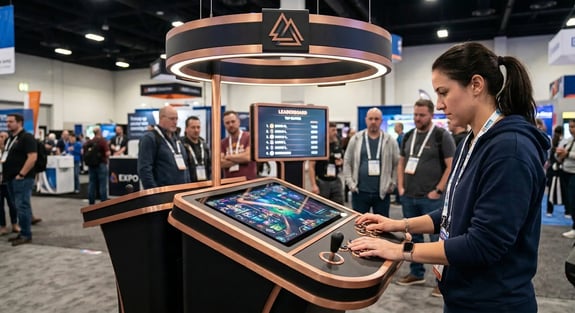
Gamification harnesses the human drive for achievement and competition. Leaderboard challenges, spin-to-win activations, and scavenger hunts all drive booth traffic and extend dwell time. For tactical ideas, explore Play to Win: Using Gamification to Boost Traffic, Engagement & Leads at Trade Shows.
Technology-Driven Immersions
AR, VR, touchscreen walls, and LED content displays transform booth spaces into portals. LED video content attracts 4x more initial attention than static graphics, according to EXHIBITOR Magazine. Pairing these technologies with a clear narrative prevents them from becoming gimmicks. See Tech-Enabled Experiences: Leveraging LED, AR/VR & Touchscreens Effectively at Trade Shows for implementation guidance.
How Do You Plan an Experiential Marketing Campaign for a Trade Show?
Planning an experiential marketing campaign requires starting 16 to 20 weeks before show day with clearly defined objectives, a deep understanding of your audience, and a phased approach connecting pre-show marketing, on-site execution, and post-show follow-up into one cohesive program.
Phase 1: Define Objectives and Audience
Begin by answering three questions: What business outcome does this show need to deliver? Who specifically are we trying to reach? What do we want those people to feel, know, or do after visiting our booth? These answers shape every downstream decision, from booth size to activation type to staffing model. If you are building a trade show planning timeline, align your experiential strategy milestones with your overall logistics calendar.
Phase 2: Concept Development and Design
With objectives locked, work with your experiential marketing agency to develop concepts that translate strategy into spatial storytelling, fabrication planning, and interactive technology integration. The strongest agencies connect creative vision with operational feasibility from the outset. Our Booth Design Blueprint for Engagement outlines the strategic design principles that underpin every successful experiential environment, from traffic flow to focal-point placement.
Phase 3: Pre-Show Activation
The experience should begin before the show opens. Targeted email campaigns, social teasers, appointment-setting, and influencer outreach all build anticipation. As detailed in The Show Before the Show, strategic pre-show marketing can double your booth traffic, giving your on-site experience a much larger audience.
Phase 4: On-Site Execution
Your staff are the human layer of the experience. Execution includes real-time lead capture, daily performance reviews, and contingency management. We recommend a consultative approach rather than a hard sell; see Stop Pitching, Start Consulting for our modern booth staff framework.
Phase 5: Post-Show Amplification
An experience that ends when the show closes is a missed opportunity. Extend the lifecycle through social content repurposing, follow-up sequences triggered by on-site interactions, and virtual recaps. Our guide to extending trade show experiences beyond the event shows how to maintain momentum after teardown.
How Should You Measure Experiential Marketing Success?
Measuring experiential marketing success requires expanding beyond cost-per-lead and badge scans. High-performing brands adopt a Return on Experience (ROX) framework that captures emotional impact, shifts in brand perception, and long-term relationship value alongside traditional financial metrics.
A seasoned experiential marketing agency will design measurement architecture before the booth is ever built, ensuring that lead capture systems, engagement tracking, and post-show analytics are integrated into the experience rather than layered on afterward.
We make the full case for this evolved measurement model in Evolving Beyond ROI: Why Return on Experience (ROX) is Your Most Valuable Metric. Here, we summarize the key components.
Quantitative Metrics
- Qualified leads generated — not just badge scans, but contacts that match your ideal customer profile.
- Dwell time — average time visitors spend in your booth environment, a direct proxy for engagement depth.
- Social amplification — shares, mentions, hashtag usage, and user-generated content created on site.
- Pipeline influenced — revenue from deals that originated from or were accelerated by the trade show interaction.
Qualitative Metrics
- Net Promoter Score (NPS) surveys administered at the booth exit.
- Sentiment analysis of social mentions and post-show survey responses.
- Brand perception shift measured via pre/post awareness studies.
For detailed measurement tactics, including which lead capture tools give you the cleanest data and how to structure your lead follow-up strategy, explore our companion posts.
"We tell our clients to think of measurement in two time horizons. The show-floor metrics, leads, dwell time, meetings, tell you if the activation worked tactically. The 90-day metrics, pipeline, closed revenue, brand lift, tell you if the experience worked strategically. You need both."
— The team at Exhibit Options
What Are the Most Common Experiential Marketing Mistakes?
The most common mistake is confusing spectacle with strategy. A visually impressive booth may generate foot traffic, but without a clear narrative arc and defined conversion pathway, attention rarely translates into revenue.
An experienced experiential marketing agency prevents this misalignment by anchoring every design element, technology choice, and activation moment to a defined business objective.
Mistake 1: Technology Without Purpose
Adding VR headsets or touchscreens because they look impressive, without tying them to a brand narrative, dilutes rather than amplifies your message. Every technology choice should answer the question: How does this help the visitor understand or experience our value proposition?
Mistake 2: Cluttered, Confusing Layouts
Overloading a booth with activations, messaging panels, and products creates cognitive overload. As we explore in The Silent Sabotage: How Cluttered Booths Drive Away Your Best Leads, simplicity and intentional flow outperform visual noise every time. The strongest experiential booths have open floor plans with clearly defined zones.
Mistake 3: Ignoring the Follow-Up
A phenomenal on-site experience means nothing if leads go cold. Our research and experience confirm that three critical mistakes silently kill trade show ROI, and a weak or delayed follow-up strategy is chief among them.
Mistake 4: One-Size-Fits-All Booth Design
Different events attract different audiences with different expectations. Your core brand story stays consistent, but the experiential execution should adapt to each show's context, including local culture and regional expectations, as discussed in Embrace Local Culture: Tailoring Trade Show Strategies.
Where Is Experiential Marketing Headed? Trends Shaping Trade Shows
Experiential marketing at trade shows is moving toward hyper-personalization, sustainability-driven design, hybrid physical-digital experiences, and AI-powered interaction. These trends are not replacing human connection; they are amplifying it, giving brands new tools to make every attendee feel like the experience was created specifically for them.
Our detailed trend analysis in The Future Is Experiential: 5 Emerging Trends in Trade Show Booth Design & Engagement unpacks each of these shifts. Below are the headlines.
AI-Powered Personalization
Artificial intelligence is enabling booths that adapt in real time. Facial recognition (where permitted), badge-scan data feeds, and conversational AI allow brands to tailor content, messaging, and product recommendations to each visitor the moment they enter the space.
Sustainable Experience Design
Attendees and exhibitors alike are demanding environmentally responsible practices. Reusable structures, recyclable materials, and carbon-offset programs are becoming baseline expectations. For more on sustainable practices, see our post on sustainability and social responsibility in trade shows.
Hybrid Physical-Digital Experiences
The line between on-site and online continues to blur. Smart exhibitors are designing experiences that extend digitally, capturing remote audiences through live streams, interactive microsites, and post-show virtual environments. This hybrid approach multiplies reach without sacrificing the intimacy of in-person engagement.
Wellness-Centered Design
Biophilic elements, lounge areas, and sensory-balanced environments are growing in popularity. Trade show floors are overwhelming, and booths that offer a moment of calm can actually boost engagement by designing for wellness.
Frequently Asked Questions
What is experiential marketing at a trade show?
Experiential marketing at a trade show is a strategy where brands create interactive, immersive environments that invite attendees to participate rather than passively observe. This includes hands-on product demos, AR/VR installations, gamification, sensory environments, and storytelling journeys. The goal is to forge emotional connections that drive recall and purchase intent. Learn more in our introductory guide.
How much does an experiential trade show booth cost?
Costs vary significantly based on footprint, complexity, technology integration, and fabrication approach. A well-executed 10x10 experiential environment may begin around $15,000–$30,000, while a fully custom 20x20 or larger build can range from $100,000 to $250,000+. The critical factor is not budget size, but strategic alignment between objectives and design investment. Our post on experiential marketing on any budget outlines smart ways to allocate your investment regardless of size.
How do you measure the ROI of experiential marketing?
Measure ROI through quantitative metrics (qualified leads, dwell time, social amplification, pipeline influenced) alongside qualitative metrics (NPS scores, brand perception shifts). The industry is adopting Return on Experience (ROX) frameworks that capture emotional and relational value. See our detailed measurement guide for step-by-step instructions.
How far in advance should you plan an experiential trade show campaign?
Begin planning at least 16 weeks before the event, though 20 or more weeks is ideal for complex builds. This timeline allows adequate time for strategy, design, fabrication, technology integration, and staff training. Rushed timelines almost always result in compromised experiences and higher costs.
What is the difference between experiential marketing and brand activation?
Experiential marketing is the overarching strategy of creating immersive brand experiences. Brand activation is a specific tactic designed to trigger a consumer action such as a trial, sign-up, or purchase. Every brand activation is experiential marketing, but not every experiential program is a single activation. We break it down in our comparison post.
Turn Your Next Trade Show Into an Unforgettable Brand Experience
Experiential marketing at trade shows is no longer a luxury reserved for Fortune 500 budgets. It is the baseline expectation of modern attendees who carry buying authority and demand more than a brochure and a handshake. From understanding the psychology that makes immersive experiences stick to planning a phased campaign, measuring what matters, and avoiding the mistakes that undermine even the best concepts, this guide has given you the strategic framework to move forward with confidence.
The data is clear: 91% of consumers feel more positive about brands after live experiences, and with the right partner, you can translate that sentiment into pipeline, revenue, and long-term brand equity. As a veteran-owned, woman-owned experiential marketing agency with fully in-house design and fabrication capabilities, Exhibit Options has been helping brands create trade show experiences that perform since 2005.
Ready to transform your next trade show presence? Contact Exhibit Options for a complimentary consultation to discover how our teams in Las Vegas and Los Angeles can bring your experiential vision to life, from concept to the show floor and beyond.

COMMENTS