
Table of Contents
- What Exhibit Components Work Best in Corporate Spaces?
- How Do You Design for Reuse from the Start?
- What Are the Practical Considerations for Repurposing?
- How Do You Calculate the ROI of Exhibit Repurposing?
- Frequently Asked Questions
Your custom trade show exhibit cost six figures to build, yet it spends roughly 48 weeks a year sealed in a warehouse. If you want to repurpose trade show exhibit assets instead of paying $500 to $3,000 per month in storage fees, you are not alone. A growing number of brands are discovering that a year-round exhibit strategy turns a seasonal expense into a permanent competitive advantage. Here is how to give your exhibit a profitable second life.
Why Is Your Custom Exhibit Sitting in a Warehouse?
Most custom exhibits are used just three to four weeks per year, which means the other 48 weeks represent pure overhead. Understanding the hidden costs of storage is the first step toward unlocking your exhibit's full value.
According to EXHIBITOR Magazine, storage fees for mid-to-large exhibits range from $500 to $3,000 per month. Over a three-year ownership cycle, that adds $18,000 to $108,000 in warehousing costs alone, on top of the $100,000 to $250,000 or more already invested in design and fabrication. Those numbers are hard to justify when the exhibit generates impressions less than 10% of the year.
The ROI argument for an exhibit second life strategy is straightforward. Instead of treating your exhibit as a depreciating asset locked in a crate, treat it as a flexible brand platform that works across multiple environments. Companies that already evaluate rental vs. ownership understand this math. Repurposing takes it further by eliminating downtime entirely.
What Exhibit Components Work Best in Corporate Spaces?
Not every part of a trade show booth translates into a permanent corporate installation, but many high-value components do. The key is matching exhibit elements to the environments where they deliver the most impact.
Modular Walls as Office Feature Walls
A branded backwall that anchors your 20x20 island booth can become a striking feature wall in a corporate lobby or conference room. According to the EDPA, 62% of exhibitors now use modular or reusable systems, and those systems reduce fabrication costs by 30 to 50% compared to full custom builds. If your walls use quality materials and durable finishes, the transition to permanent installation is seamless.
Interactive Kiosks as Customer Experience Stations
Touchscreen kiosks and product configurators are expensive to develop. Placing them in a corporate showroom design after the show extends their useful life. Forrester research via Event Marketer found that 65% of B2B buyers say in-person brand experience is "very important" in vendor selection. An interactive station in your office serves that function year-round.
Branded Environments as Showroom Vignettes
Product demo areas, lifestyle vignettes, and themed meeting spaces often represent the highest-value sections of a custom exhibit. These can be reconfigured as permanent showroom displays. The materials and textures that create an emotional response on the show floor produce the same effect in a dedicated showroom.
LED and AV Elements as Lobby Displays
LED video walls and integrated AV systems are among the most expensive exhibit line items. Relocating them to a reception area or executive briefing center ensures they deliver impressions every business day rather than four days per show.
Meeting Furniture as Executive Briefing Room Pieces
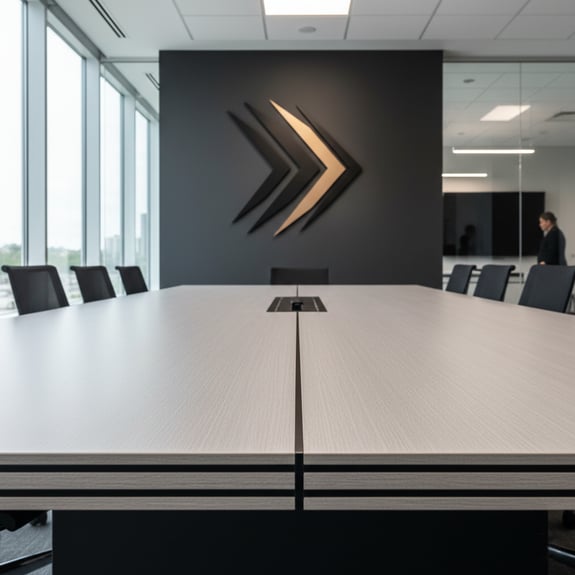
Custom-fabricated tables and seating built for the booth can serve executive briefing rooms. Pieces produced with in-house fabrication capabilities like 6-axis CNC machining are built to withstand repeated trade show I&D and will more than hold up in a permanent office setting.
How Do You Design for Reuse from the Start?
The most cost-effective way to repurpose a trade show exhibit is to plan for it during the initial design phase. Designing for dual use from day one is far more efficient than retrofitting after the fact.
Durable finishes rated for permanent install are the foundation. Specify commercial-grade laminates, powder-coated metals, and UV-resistant graphics that perform under both convention-center lighting and daily office use. A thorough materials guide helps you make the right selections.
Flexible mounting systems matter because convention centers use rigging and pipe-and-drape infrastructure that does not exist in offices. Designing wall sections with both freestanding capability and standard wall-mount hardware means your display adapts to either context.
Technology that works outside convention centers is essential. Specify displays and interactive elements that run on standard 120V circuits and connect via Wi-Fi so they function in any environment.
Finally, dimensions that fit corporate spaces require deliberate planning. A 20-foot backwall may overwhelm an office hallway. Designing in modular sections gives you flexibility for the full wall at shows and individual modules in the office. This is the same principle behind scalable design.
"We encourage every client to think about where their exhibit will live between shows. When we design a custom booth, we are already considering how those components can serve their headquarters or customer experience centers. That dual-purpose mindset is what separates a one-time expense from a long-term brand asset."
— The team at Exhibit Options
Working with your exhibit partner simultaneously on both applications is critical. EXHIBITOR Magazine reports that 39% of exhibitors now use a hybrid approach combining custom and modular elements, and that number is growing because hybrid systems lend themselves to flexible deployment across multiple settings.
What Are the Practical Considerations for Repurposing?
Transitioning exhibit components from a convention center to a corporate environment involves practical factors that are easy to overlook. Addressing them early prevents costly surprises.
Electrical and AV infrastructure is the most common hurdle. Convention centers provide 208V and 480V power that offices do not. Components requiring high-amperage service will need redesigned power distribution, and AV systems may need reconfiguration for corporate IT networks.
Wall mounting versus freestanding deployment affects structural planning and code compliance. Verify that the host building's walls can support the load, particularly for heavy elements like stone-clad panels or large monitors.
Lighting environment changes can alter how your exhibit looks. Convention halls use high-intensity overhead lighting while offices use lower ambient levels. Plan to add dedicated accent lighting to replicate the show-floor visual impact.
Maintenance requirements increase with permanent installation. Specify easily cleanable surfaces, replaceable graphic panels, and serviceable electronics to keep the installation looking fresh.
Updating graphics is often necessary. Show-specific messaging looks out of place in a permanent installation. Budget for evergreen graphic panels designed for the corporate context.
ADA compliance in office settings carries different requirements than trade show floors. Permanent installations must comply with ADA standards for accessible routes and reach ranges. A solid budget planning process should account for these adaptation costs.
How Do You Calculate the ROI of Exhibit Repurposing?
The financial case for trade show asset reuse becomes clear when you compare cost per use and total impressions between a show-only strategy and a repurposed strategy.
Assume a custom 20x20 exhibit with a fabrication cost of $150,000 (based on the $100,000 to $250,000 range reported by EXHIBITOR Magazine), three shows per year at $8,000 each for I&D, storage at $1,500 per month, and a three-year useful life.Cost-Per-Use Comparison:
Cost-Per-Use Comparison: Show-Only vs. Repurposed Exhibit (3-Year Lifecycle)
| Cost Category | Show-Only | Repurposed |
|---|---|---|
| Fabrication | $150,000 | $165,000 (dual-use spec) |
| I&D (3 shows/yr x 3 yrs) | $72,000 | $72,000 |
| Storage (3 years) | $54,000 | $18,000 (reduced inventory) |
| Corporate installation | $0 | $15,000 |
| Graphic refresh | $0 | $5,000 |
| Total 3-Year Investment | $276,000 | $275,000 |
| Estimated Total Impressions | ~27,000 (show only) | ~57,000 (shows + office) |
| Cost Per Impression | $10.22 | $4.82 |
The "total impressions" framework captures the full picture. Trade show impressions are limited to the days your booth is open. A corporate installation generates impressions from every employee, client, vendor, and candidate who walks through your door across 250+ business days per year. The repurposed strategy costs essentially the same over three years but generates more than double the impressions, dropping cost per impression from $10.22 to $4.82, a 53% improvement.
Frequently Asked Questions
Can I repurpose an exhibit that was not originally designed for dual use?
Yes. The process typically involves reinforcing structural elements for permanent mounting, upgrading finishes for long-term durability, and reworking electrical connections for standard office power. The retrofit cost is higher than designing for dual use from the start, but it is almost always less expensive than building a new corporate installation from scratch.
How long does it take to transition an exhibit to a corporate space?
A well-planned transition typically takes two to four weeks, including logistics, modifications, and professional installation. If the exhibit was designed for reuse from the start, the timeline can be shorter because mounting systems, electrical connections, and dimensional planning are already in place.
Does repurposing reduce the effectiveness of my exhibit at trade shows?
Not when planned correctly. Modular construction allows you to deploy the full exhibit at trade shows while installing select components in your corporate space between events. The EDPA reports that 62% of exhibitors already use modular or reusable systems, and these perform at the same level as single-purpose custom builds on the show floor.
Stop Storing Your Investment and Start Deploying It
Your custom exhibit represents one of the largest single investments in your marketing budget. Every month it sits idle, that investment depreciates without generating a single impression. By planning for repurposing from the design phase, you transform a seasonal marketing tool into a permanent brand asset.
At Exhibit Options, we design and fabricate exhibits with second-life strategy built in from the first sketch. Our in-house fabrication capabilities, including 6-axis CNC machining at our facilities in Las Vegas and Cerritos, California, mean we control quality from concept through both trade show deployment and corporate installation. As a veteran-owned and woman-owned agency founded in 2005, we have spent two decades helping brands maximize the return on every exhibit dollar.
Ready to give your exhibit a second life? Contact Exhibit Options to discuss how your current or next custom exhibit can serve your brand on the show floor and in your corporate spaces, all year long.

COMMENTS