
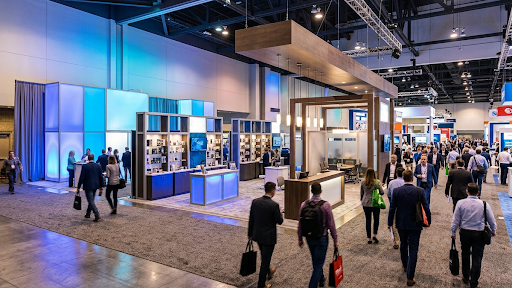
Choosing a trade show booth size comes down to four things: your goal, your budget, the floor space you've reserved, and where you're headed next. A 10x10 inline booth is the entry point, a 10x20 doubles your presence, and a 20x20 island makes your brand a destination on the floor.
Key Takeaways
- A 10x10 booth is 100 sq ft, a 10x20 is 200 sq ft, and a 20x20 island is 400 sq ft, so each step up doubles your usable space.
- Inline booths (10x10, 10x20) sit in a row and open to one or two aisles. Island booths are open on all four sides and accessed from every direction.
- Match the size to your goal: 10x10 for lead capture and brand presence, 10x20 for product demos and meetings, 20x20+ for launches and high foot traffic.
- A 10x20 designed with modular, reconfigurable parts can scale into a 20x20 island without a full rebuild.
What are the standard trade show booth sizes?
Trade show booths come in standard 10-foot increments, and the three most common footprints are the 10x10 (100 sq ft), the 10x20 (200 sq ft), and the 20x20 island (400 sq ft). Booth space is sold by the 10x10 unit, so a 10x20 is two units and a 20x20 is four. Most exhibit halls assign space this way.
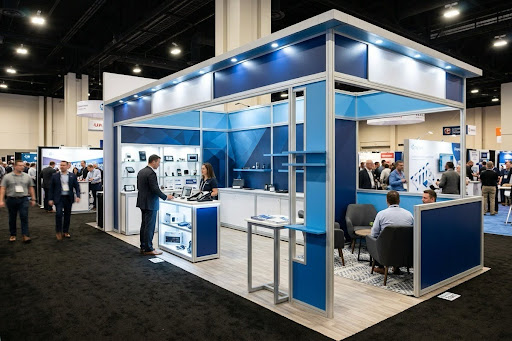
The bigger distinction isn't square footage, it's booth type. Inline booths sit in a row with neighbors and a back wall, opening to the aisle in front and to one end at a corner. Island booths stand alone with aisles on all four sides. A peninsula sits at the end of a row, open on three sides with one shared back wall. Each type changes how visitors approach you and how your design has to work.
|
Booth size |
Square footage |
Booth type |
Typical use |
|
10x10 |
100 sq ft |
Inline |
First-time exhibitors, lead capture, brand presence |
|
10x20 |
200 sq ft |
Inline |
Product demos, a private meeting area, growing brands |
|
20x20 |
400 sq ft |
Island or peninsula |
Launches, high traffic, multi-zone experiences |
|
20x30 / 20x40+ |
600+ sq ft |
Island / double-deck |
Anchor brands, hospitality, full activations |
What is a 10x10 trade show booth good for?
A 10x10 trade show booth is the standard 100 sq ft inline space, and it's the right call when your goal is a clean, professional presence and steady lead capture. It fits a back wall with bold graphics, a counter or kiosk, product shelving, and one or two staff. Most first-time exhibitors start here, as do seasoned brands at regional or niche shows where a bigger footprint isn't worth the cost. The constraint is space. A 10x10 opens to one aisle, so your message has to land in three seconds, and the design works best when it's built around one clear message and one clear action.
What is a 10x20 trade show booth good for?
A 10x20 trade show booth doubles your space to 200 sq ft and is the workhorse size for growing brands. The extra width lets you add a product demo area, a semi-private meeting space, a larger graphic story, and storage, and to separate "attract" from "engage" instead of cramming both into one wall. It's still inline, opening to the aisle in front, but you get real presence without the cost of an island. One advantage stands out: a 10x20 built with modular, reconfigurable components can split into two 10x10s for smaller shows or grow into a 20x20 island later. See our our breakdown of scalable trade show booths for how to design a 10x20 that grows without starting over.
What is an island booth or 20x20 trade show booth?
An island booth is a freestanding exhibit open on all four sides, and a 20x20 (400 sq ft) is the most common entry point. Because aisles surround it, visitors approach from every direction, so there's no back wall to hang your story on. The structure has to read from 360 degrees with a tall central element, hanging signage, and zones that pull people in. This is the size for launches, high-traffic shows, and experiences that need room to breathe: product theaters, lounge areas, multiple demo stations, and private meeting rooms. A peninsula booth is the half-step in between, open on three sides with one shared back wall, giving you island-style visibility at a lower cost. Both reward a custom trade show exhibit design built for an experience, not just a display.
How do you choose the right trade show booth size?
Choose your trade show booth size by working through five factors in order: goal, budget, floor space, staffing, and growth plan. Each one narrows the field, and together they point clearly to 10x10, 10x20, or island.
- Start with your goal. Lead capture and brand presence point to a 10x10. Product demos and on-floor meetings point to a 10x20. A launch or a high-traffic hall points to a 20x20 island or larger.
- Set the budget honestly. Booth size drives nearly every other cost: space rental, structure, graphics, shipping, drayage, electrical, and labor. A bigger footprint multiplies all of them, not just the build.
- Confirm the floor space you can reserve. Check the show's floor plan and what's available. A premium island or corner spot may be sold out, which can settle the question for you.
- Match staffing to size. A 10x10 runs on one or two people, a 10x20 on two to four. An island needs a full team to cover every side, because empty space reads as a dead booth.
- Plan for where you're headed. If you exhibit several times a year and expect to grow, buy a system that scales. Designing for the next size up now is cheaper than rebuilding later.
How do you scale a 10x20 into a 20x20 island?
You scale a 10x20 into a 20x20 by designing it modular from day one, so the same components reconfigure into a larger footprint instead of getting scrapped. Engineer the booth as a kit of parts (reconfigurable panels, structures, and graphics) rather than one fixed build: components sized to combine, graphics in swappable sections, and a structure that adds zones without replacing the core. Done right, a 10x20 inline splits into two 10x10s for smaller shows and expands into a 20x20 island for your flagship, all from one investment. It's the same modular thinking that lets brands keep visitors engaged across booth sizes without rebuilding each show.
Should you rent or buy a trade show booth at each size?
Whether you rent or buy depends on how often you exhibit and how custom you need to look, and the answer often shifts with size. Renting a custom-look exhibit makes sense for one-off shows, a new market you're testing, or a year you need to control costs. It works at every size from a 10x10 to a full island, with no commitment to own, store, and refurbish. Buying makes sense when you exhibit regularly and want a consistent presence you control, especially at 10x20 and up where a modular owned system scales. Many brands run a hybrid: own a core 10x20 and rent to expand into an island for flagship events. Compare custom trade show exhibits and exhibit rentals to find your fit.
Frequently Asked Questions
How many square feet is a 20x20 booth?
A 20x20 trade show booth is 400 square feet, which is four standard 10x10 units combined. That's enough room for multiple zones in one exhibit, such as a product theater, a lounge or hospitality area, several demo stations, and a private meeting space, all within a single island footprint open on all four sides.
How big is a 10x10 vendor booth?
A 10x10 booth is 100 square feet, the standard single-unit inline space at most trade shows. It comfortably fits a branded back wall, a counter or kiosk, product display, and one or two staff. It's the most common starting size for first-time exhibitors and for brands attending regional or niche shows.
What's the difference between an inline booth and an island booth?
An inline booth sits in a row with neighbors on either side and a back wall, opening to one aisle (or two at a corner). An island booth stands alone with aisles on all four sides, so visitors approach from every direction. Inline booths tell a story from the front; islands must read from 360 degrees.
What is a peninsula booth?
A peninsula booth sits at the end of a row and is open on three sides, sharing one back wall with a neighboring booth. It offers island-style visibility (visitors approach from three directions) at a lower cost and footprint than a full island, which makes it a popular step up from an inline 10x20.
How much does a trade show booth cost by size?
Cost scales with size across space rental, structure, graphics, shipping, drayage, and labor. Beyond the build, a bigger booth multiplies every line item, so the best way to budget is a detailed proposal that lists each cost before you commit to a size.
Can a small booth still stand out at a trade show?
Yes. A well-designed 10x10 can outperform a generic larger booth. With a focused message that lands in three seconds, bold graphics, and one clear call to action, a small footprint captures attention. Design and clarity decide whether a booth gets noticed, not size alone.
Ready to choose the right booth size?
Whether you're sizing up your first 10x10 or planning a 20x20 island launch, we design, build, and install every size in-house across our Cerritos and Las Vegas facilities, so what you approve in 3D is exactly what shows up on the floor. Tell us your goals, your show calendar, and your budget, and we'll recommend the size and approach that fit. Get a booth design quote and let's build something that stands out.
By Rena Patton — Co-founder of Exhibit Options, a single-source exhibit house since 2005, designing, engineering, fabricating, and installing custom trade show exhibits and rentals in-house from its Cerritos, CA and Las Vegas, NV facilities. Veteran-owned and woman-owned.

COMMENTS