
Key Takeaways
- Trade show booth displays fall into five buyable types: portable and banner stands, pop-up and tension fabric, modular, backdrops, and custom-built exhibits.
- Portable and pop-up displays suit 10x10 inlines and tight budgets, while modular and custom displays scale to islands and reconfigure across multiple shows.
- Your graphics decide whether the booth works. Design for a three-second read at fifteen feet, and print large-format files at 100 ppi at full size.
- Rent when a show is one-off or the schedule is unpredictable. Buy when you exhibit repeatedly and want an owned brand presence.
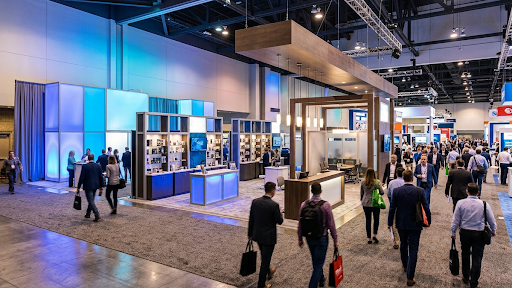
Trade show booth displays are the physical structures and graphics that present your brand on a show floor, ranging from a single portable banner stand to a fully custom-built island exhibit. The right one depends on three things: your booth size, how often you exhibit, and what you need the space to do. This guide walks through every display type, the graphics that make them work, cost ranges, and the rent-versus-buy decision. Exhibit Options has designed and built exhibits since 2005, so these recommendations come from what performs on the floor.
What is a trade show display?
A trade show display is the structural and graphic system that frames your presence in an exhibit space, from a backwall and banner stands up to a complete custom environment with lighting, flooring, and product integration. Displays are categorized by how they're built and transported: portable, pop-up, modular, or custom. Whatever the type, the job stays the same: capture attention from across the aisle and make your brand memorable.
What are the types of trade show booth displays?
There are five practical types of trade show booth displays, each fitting a different booth size, budget, and reuse pattern.
Portable displays and banner stands
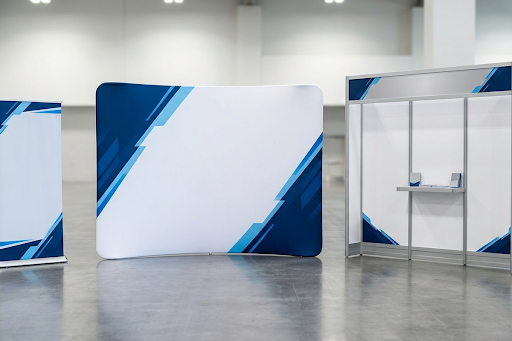
Portable displays are lightweight, self-assembling units that pack into a case and set up in minutes without tools. Retractable banner stands are the entry point: a graphic that rolls up into its own base, ideal for entrances, aisles, and 10x10 spaces. They cost the least and travel as checked luggage, the right pick when you exhibit occasionally or work a tight budget. The trade-off is presence. A banner stand is a starting point, not a destination.
Pop-up and tension fabric displays
Pop-up displays use an accordion frame that expands into a curved or straight backwall, with graphics that attach magnetically or through a printed fabric skin. Tension fabric displays stretch a single seamless dye-sublimated graphic over an aluminum frame for the cleanest, most modern look at the price. Both pop up fast and pack small. Tension fabric is the better buy for most exhibitors, because its graphics are machine-washable, wrinkle-resistant, and replaceable without rebuying the frame.
Modular displays
Modular displays are built from a reconfigurable kit of frames, panels, and connectors that reassemble into different sizes and layouts. The same components that form a 10x20 inline can rebuild into a 20x20 island. You buy once and adapt the footprint per event, which makes modular the sweet spot for companies exhibiting at several shows a year.
Backdrops
A trade show backdrop is the back wall of your booth, the largest single graphic surface and your most valuable real estate. Backdrops come as tension fabric, pop-up, rigid panel, or hanging structures, depending on whether you need it portable, reconfigurable, or built to spec. Treat it as the anchor of the display. Your logo, headline, and dominant brand color all live here, and they have to read from across the aisle.
Custom exhibits
Custom exhibits are designed and engineered from scratch around your brand, products, and goals, with no off-the-shelf kit dictating the layout. This is where lighting, flooring, demo stations, storage, meeting space, and technology integrate into one environment. Custom is the move when the booth has to do real work, such as launching a product, hosting meetings, or owning a space against larger competitors. It costs the most, but it's the only path to a display that's genuinely yours. Our fully custom trade show exhibits run from strategy to installation under one roof.
What makes a good trade show display?
A good trade show display reads in three seconds from fifteen feet away, communicates one clear message, and pulls people in. The structure gets the credit, but the graphics do the work.
Trade show graphics: specs and materials
Graphics print on a few common substrates, and the choice drives both look and longevity:
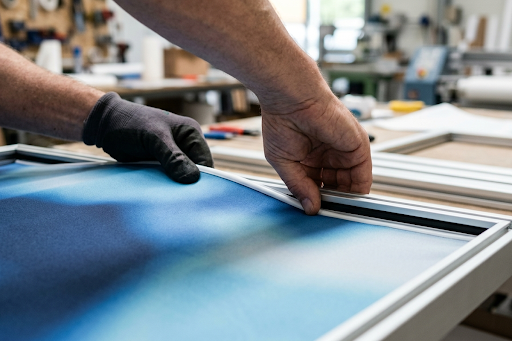
- Dye-sublimated fabric infuses dye into polyester for a matte, seamless, machine-washable finish, the standard for tension fabric displays.
- Rigid panels (PVC, aluminum composite, acrylic) suit backlit walls, hard counters, and any surface that needs a flat, premium feel.
- Vinyl is the workhorse for banner stands and floor graphics, durable and inexpensive but prone to glare under show lighting.
Build large-format files at 100 ppi at full size in CMYK with bleed, and keep text and logos inside the safe zone so seams and frame edges don't cut through them. Always use vector logos. A low-resolution logo blown up to backwall size is the most common graphics failure.
Common graphics mistakes
The mistakes that sink a display are almost always in the graphics:
- Too many words. A backdrop is a billboard, not a brochure. One headline, one supporting line.
- Logo and headline placed too low. Crowds block the bottom three feet, so anchor your message in the top two-thirds.
- Weak contrast. Show-floor lighting is harsh. High-contrast color reads, while subtle gradients disappear.
- Off-brand color drift. Printed color shifts from your screen, so approve a color-managed proof before the full run.
For the full breakdown of substrates and finishes, see our exhibit materials guide. And designing a booth that draws people in is its own discipline.
How much does a trade show display cost?
A trade show display ranges from roughly $300 for a single retractable banner stand to $150,000 or more for a large custom island. Here's the practical spread:
|
Display type |
Typical range |
Best for |
|
Banner stands |
$300 – $1,500 |
Entrances, aisles, 10x10 add-ons |
|
Pop-up / tension fabric backwall |
$1,500 – $6,000 |
10x10 to 10x20 inline booths |
|
Modular display |
$8,000 – $40,000 |
Multi-show exhibitors, reconfigurable footprints |
|
Custom exhibit |
$40,000 – $150,000+ |
Islands, product launches, flagship presence |
These figures cover the display itself. Budget separately for graphics refreshes, shipping and drayage, installation and dismantle, and storage. A detailed proposal itemizes each one up front.
Should I rent or buy a trade show display?
Rent a trade show display when you exhibit infrequently or want a custom look without the capital outlay. Buy when you exhibit repeatedly and want an owned brand presence. The math turns on frequency.
At one or two shows a year, renting almost always wins. You skip storage, refurbishment, and owning an asset that sits idle most of the year, and our exhibit rental options deliver a custom-look booth for a single event at a fraction of the buy price. At four or more shows a year, buying a modular or custom display earns its cost back fast. Many exhibitors blend the two: own a modular kit, then rent extra for the big shows.
Portable vs. custom: which should I choose?
Choose a portable display when budget, frequency, and footprint are all small. Choose custom when the booth has to accomplish a business goal an off-the-shelf kit can't deliver. The deciding question isn't price, it's what the booth needs to do, with modular sitting between the two at a lower entry cost. If you're weighing builders, how to choose the right exhibit partner covers what to look for.
How Exhibit Options helps you choose and build
Exhibit Options is a single-source exhibit house. Design, engineering, fabrication, graphics, logistics, and installation all happen under one roof at our Cerritos, CA and Las Vegas, NV facilities, two West Coast locations that cut your shipping and drayage costs. Whether you need portable trade show displays, a modular system, or a fully custom build, we match the display to your goals and budget, then build exactly what you approved. Start the planning conversation with our team to map the right display to your next show.
Frequently Asked Questions
What is the difference between a pop-up and a tension fabric display?
A pop-up uses an accordion frame with graphics that attach in panels; a tension fabric display stretches one seamless printed skin over an aluminum frame. Tension fabric looks cleaner, and its graphics are machine-washable and replaceable.
What size trade show display do I need?
A pop-up or tension fabric backwall covers a 10x10 inline, a modular system suits 10x20 and larger, and a custom island fits 20x20 and up. Confirm your exact dimensions and rigging rules with the show first.
How long does it take to produce a custom trade show display?
A custom exhibit typically takes six to twelve weeks from approved design to a staged, ship-ready build, so start at least three months out. Portable and pop-up displays with print-ready graphics ship in a few business days.
Can I reuse the same trade show display at multiple shows?
Yes. Modular and custom displays reconfigure and reship across events, and refreshing the graphics keeps the messaging current without rebuilding the structure. Portable displays travel easily but flex the least.
What file format and resolution do trade show graphics need?
Supply vector files (AI, EPS, or PDF) for logos and type, and raster images at 100 ppi at full print size in CMYK with bleed. Large-format prints at lower ppi because it's viewed from a distance, but source files must still avoid pixelation.
Is it cheaper to rent or buy a trade show booth display?
Renting is cheaper at once or twice a year, since you avoid storage, refurbishment, and owning an idle asset. Buying wins at roughly four or more shows a year, when the per-show cost of an owned display drops below the rental fee.

COMMENTS