
Table of Contents
-
What Is Co-Exhibiting and When Does It Make Strategic Sense?
- What Are the Design Challenges of a Shared Exhibit Space?
- How Do You Handle the Business Side of Co-Exhibiting?
- How Should You Evaluate Whether a Co-Exhibiting Arrangement Worked?
- When Should You NOT Co-Exhibit?
- Frequently Asked Questions
Co-exhibiting at trade shows is one of the smartest — and least discussed — strategies in the exhibit world. Whether you are a startup entering an unfamiliar market or a corporate parent uniting subsidiaries, sharing booth space can cut costs and amplify your show floor presence. But a poorly planned arrangement dilutes both brands. This guide covers when sharing makes sense as part of a broader year-round exhibit strategy.
What Is Co-Exhibiting and When Does It Make Strategic Sense?
Co-exhibiting is a formal arrangement in which two or more brands share a single exhibit footprint, splitting costs while presenting a unified yet distinct presence. It involves deliberate design coordination, agreed-upon cost structures, and aligned marketing goals.
Several scenarios make co-exhibiting at trade shows a sound choice. Corporate parents unite subsidiaries inside one island booth, projecting scale. Channel partners co-exhibit to demonstrate a complete solution neither could tell alone. Industry consortiums organize partner pavilions where members share a branded environment at a fraction of solo cost.
Startups benefit too. Co-exhibiting with an established partner lends credibility you would struggle to generate alone. According to EXHIBITOR Magazine, companies allocate 60-70% of their budget to anchor shows, leaving limited funds for secondary events. Sharing space at those shows lets you gather data without overextending. Review our budget checklist if you are weighing the financial commitment.
And consider this: 76% of attendees pre-plan booth visits (CEIR). Two brands sharing a listing effectively double pre-show visibility in the event directory.
What Are the Design Challenges of a Shared Exhibit Space?
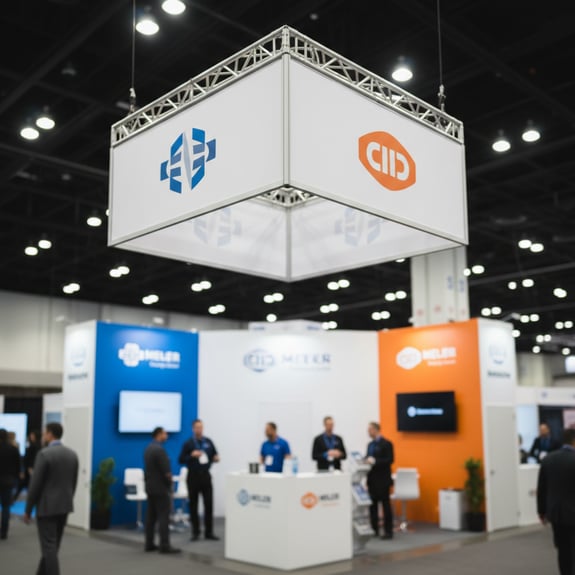
The biggest design challenge in a shared booth space is maintaining distinct brand identities within a unified experience. Attendees should immediately understand there are two brands present, what each offers, and how they relate — without feeling visually overwhelmed.
Start with signage hierarchy. Both brands need prominent identification, but one logo should not tower over the other unless the agreement positions a "host" and "guest." Color zones help: assign each partner a defined area using their brand palette, then unify the structure with a neutral framework. This is where graphics and signage planning becomes essential.
Traffic flow requires equal attention. The "who gets the back wall" problem arises when one partner occupies the rear graphic while the other is relegated to a side counter. Thoughtful layout — angled counters, shared demo stations, a central meeting hub — distributes attention equitably. Avoid the cluttered booth mistakes that plague shared spaces when two brands cram independent messaging into one footprint.
Shared versus dedicated meeting areas matter too. A semi-private room between both zones works for joint selling; separate sales cycles may require two smaller areas. Good design makes the partnership feel intentional, not like a compromise
"The best co-exhibiting environments we build don't look like two booths shoved together — they look like one cohesive story told by complementary voices. That requires design thinking from day one, not an afterthought."
— The team at Exhibit Options
Modular and hybrid exhibits are especially well suited here. According to EDPA, modular systems reduce fabrication costs by 30-50%, and their reconfigurable nature lets the same components accommodate different partners at different shows. Combined with scalable booth design, a modular co-exhibit flexes from 20x20 to 10x20 without a full rebuild.
How Do You Handle the Business Side of Co-Exhibiting?
The business logistics of co-exhibiting demand written agreements well before the show. Without them, you invite disputes over costs, leads, and asset ownership that damage both the partnership and your ROI.
Cost-splitting agreements should detail how space fees, fabrication, shipping, drayage, and labor are divided. Common models include a 50/50 split, a proportional split based on square footage, or a host/guest arrangement where the primary exhibitor covers structural costs and the guest pays a flat fee.
Lead attribution rules are critical. Decide before the show whether leads at a shared demo station belong to both brands or are assigned by conversation content. A shared lead capture system with brand tagging solves this, but it requires staff training.
Asset ownership is often overlooked. Who owns the structure after the show? EXHIBITOR Magazine reports that 78% of companies outsource exhibit design and fabrication, meaning an experienced exhibit partner can manage the build and storage for both parties.
Also codify: labor responsibilities, insurance certificates naming both parties, electrical orders, and a single point of contact for show management.
Co-Exhibiting vs. Solo Exhibiting: A Quick Comparison
| Factor | Co-Exhibiting | Solo Exhibiting |
|---|---|---|
| Cost per brand | Lower — shared space, services, and labor | Full budget responsibility |
| Brand control | Shared — requires design coordination | Complete control over messaging and layout |
| Lead attribution | Requires pre-agreed rules and tagging | All leads belong to your brand |
| Pre-show visibility | Higher — multiple brands in one listing | Single-brand listing only |
| Booth footprint | Larger presence at lower individual cost | Footprint matches your budget exactly |
| Complexity | Higher — legal, design, and logistics coordination | Lower — single decision-maker |
How Should You Evaluate Whether a Co-Exhibiting Arrangement Worked?
Evaluating a co-exhibiting arrangement requires metrics that measure both individual brand impact and the health of the partnership. Standard booth performance numbers alone are not enough.
Leads per brand is the starting point. Compare each partner's lead volume against what they would expect from a solo booth of equivalent size. If one brand captured 80% of leads while occupying 50% of the space, the arrangement needs redesigning.
Traffic flow equity matters too. Post-show heat mapping or staff observation logs reveal whether attendees engaged equally with both zones. Even a quick three-question attendee survey tells you whether visitors understood the partnership.
Run a cost-per-lead comparison against your solo exhibiting history. If co-exhibiting reduced your cost per qualified lead by 25% or more, the arrangement delivered clear value. Factor in secondary benefits: media mentions, social amplification from your partner's channels, and new network relationships.
Finally, assess partner satisfaction directly. A post-show debrief creates the framework for deciding whether to repeat. EXHIBITOR Magazine notes that 64% of exhibitors prefer single-source partners for efficiency — the same principle applies here. Consistency compounds over multiple shows.
When Should You NOT Co-Exhibit?
Co-exhibiting is not universally beneficial. There are clear situations where sharing space will damage your brand or confuse your audience. Recognizing them upfront saves money and reputational risk.
Do not co-exhibit when brands compete for the same buyer. If both partners sell overlapping solutions to the same decision-maker, the booth becomes a comparison shopping environment. The partnership must be complementary, not competitive.
Avoid it when the booth is too small for two identities. Two brand stories in a 10x10 results in clutter where neither communicates effectively. Understanding booth types helps determine the minimum viable footprint for a multi-brand environment.
Walk away when one partner will visually dominate. If your co-exhibitor insists on 70% of signage real estate and the prime demo position, you are not co-exhibiting — you are subletting.
Finally, skip co-exhibiting when the partnership sends confusing market signals. If your audience cannot immediately understand why these two brands are together, credibility suffers. The narrative must be obvious at a glance.
Frequently Asked Questions
How much space do you need for a co-exhibiting booth?
A minimum of 20x20 feet is recommended for two brands. This provides room for distinct brand zones, a shared meeting area, and clear aisle-facing signage for both partners. Smaller footprints force compromises that hurt visibility and messaging clarity for one or both brands.
Can you co-exhibit with a rental booth instead of a custom build?
Yes. Rental and modular exhibits reconfigure for different partners or shows without a full redesign. EDPA data shows modular systems cut fabrication costs by 30-50%, making shared-space arrangements more accessible. The key is working with a fabrication partner who customizes graphics and layout within the rental framework.
Who should manage the relationship with show management when co-exhibiting?
Designate one primary contact for all show management communications — service orders, electrical, labor, and badge registration. This is typically the partner who holds the booth space contract. Two contacts submitting conflicting orders creates costly confusion. Document this role in your agreement before any orders are placed.
Build Your Co-Exhibiting Strategy with the Right Partner
Co-exhibiting at trade shows is a powerful strategy when executed with intentional design, clear agreements, and the right fabrication partner. At Exhibit Options, we bring over two decades of experience as a veteran-owned and woman-owned experiential marketing agency with full in-house fabrication — including 6-axis CNC — at our facilities in Las Vegas and Cerritos, California. Whether you need a shared island exhibit for two corporate divisions or a flexible partner pavilion that reconfigures show to show, our team designs, builds, and manages the entire process under one roof.
Contact Exhibit Options to start planning your next co-exhibiting program.

COMMENTS