
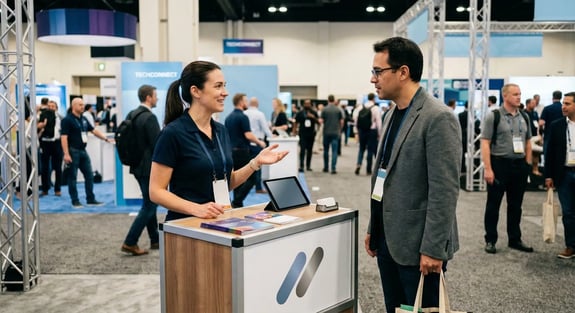
The average mid-to-large B2B company exhibits at 10 to 15 trade shows per year, according to EXHIBITOR Magazine. Yet most treat each show as a standalone event — a burst of activity followed by silence until the next one. That approach leaves compounding brand value, lead nurturing momentum, and fabrication investment on the table. The companies winning the most from experiential marketing are the ones building a year-round exhibit strategy that extends far beyond any single show floor.
This guide introduces five strategies that transform your exhibit program from a series of isolated events into a continuous brand presence. Each links to a deeper resource so you can act on the approach that fits your goals.
Why Does a One-Show Mindset Limit Your Results?
A year-round exhibit strategy outperforms one-off trade show participation because brand impressions compound over repeated touchpoints. When each show operates in isolation, your team reinvents messaging, rebuilds momentum, and loses the data continuity that sharpens targeting over time.
Research from CEIR shows that 76% of attendees plan their booth visits before arriving. If your brand only appears once a year, you are invisible for the other eleven months of planning cycles. A programmatic approach — where trade shows, partner events, pop-ups, and permanent spaces reinforce each other — keeps your brand in the consideration set continuously.
The strategic shift is straightforward: stop asking "How do we win this show?" and start asking "How does every activation build on the last?"
Here are five ways to make that shift.
How Can You Expand Where and How You Exhibit?
1. Build an Annual Multi-Show Program
Rather than budgeting show-by-show, tier your annual calendar into flagship, secondary, and exploratory events. Allocate your largest investment to two or three anchor shows, then extend reach with smaller regional or vertical events that cost less but target tighter audiences. This lets you test messaging at smaller shows and scale what works to your flagships.
A programmatic approach also unlocks fabrication efficiencies. In-house fabrication partners can design modular exhibit systems that reconfigure across booth sizes — a 20x20 island at your anchor show becomes a 10x20 inline at a regional event. According to EDPA, modular systems can reduce fabrication costs by 30-50% compared to building separate custom exhibits for each show.
Go deeper: Building an Annual Exhibit Program: Why Multi-Show Strategy Beats One-Off Thinking
2. Co-Exhibit with Strategic Partners
Not every show requires a solo booth. Co-exhibiting with complementary brands, channel partners, or subsidiaries lets you share costs while reaching new audiences. Partner pavilions are especially effective at industry consortium events where buyers expect to see integrated solutions rather than individual vendors.
The key is maintaining distinct brand identities within a shared footprint. Smart spatial design — separate engagement zones, co-branded but visually differentiated graphics, and shared hospitality areas — makes the partnership feel intentional rather than compromised. This approach is especially powerful for companies entering a new trade show market where solo investment is hard to justify.
Go deeper: Co-Exhibiting and Partner Pavilions: When Sharing Booth Space Makes Strategic Sense
3. Launch Pop-Up Activations and Mobile Experiences
Trade shows happen on someone else's schedule. Brand activations like pop-ups, mobile tours, and experiential installations put you in front of your audience on your terms — in their city, at their conference, or alongside cultural events they already attend.
The experiential marketing market is projected to reach $195 billion by 2030, according to Grand View Research, and much of that growth is happening outside traditional show floors. The spatial design, fabrication, and logistics expertise behind a great trade show booth translates directly to pop-up retail environments, mobile tour vehicles, and experiential marketing activations.
Go deeper: Pop-Up Activations and Mobile Brand Experiences: Taking Your Exhibit on the Road.
How Do You Extend Exhibit ROI Between Shows?
4. Repurpose Exhibit Assets for Corporate Spaces
A custom exhibit sitting in a warehouse 48 weeks a year is an underperforming asset. Modular walls become office feature walls. Interactive kiosks become customer experience stations. Branded environments become showroom vignettes that impress visiting prospects year-round.
Designing for reuse from the start is the key. When your exhibit partner plans a "second life" strategy during the initial design phase, components are built with corporate installation in mind — durable finishes, flexible mounting systems, and technology that works outside a convention center. This approach can effectively halve your cost-per-use for custom fabrication.
Go deeper: Repurposing Trade Show Exhibits for Corporate Showrooms and Lobbies
5. Invest in a Brand Experience Center
The ultimate expression of a year-round exhibit strategy is a permanent brand experience center — an immersive, interactive space at your headquarters or a neutral location where top prospects, partners, and customers experience your brand on demand. According to Event Marketer, 65% of B2B buyers say a positive in-person brand experience is "very important" in vendor selection.
A brand experience center borrows heavily from trade show design — multisensory engagement, narrative-driven spatial flow, and interactive technology — but adapts it for repeated visits, longer dwell times, and personalized tours. It becomes the place you invite high-value accounts after the trade show handshake.
Go deeper: Brand Experience Centers: Permanent Showrooms Inspired by Trade Show Design
Where Should You Start?
You do not need to execute all five strategies at once. Start by auditing your current exhibit program with three questions:
- How many shows are we doing, and are they working as a system? If not, begin with an annual planning framework.
- What happens to our exhibit assets between shows? If they sit in storage, explore repurposing or modular design-for-reuse.
- Are we reaching our audience only when they attend trade shows? If yes, pop-ups and brand experience centers fill the gap.
The common thread across all five strategies is design and fabrication expertise. The same team that builds an immersive 20x20 island booth can design a mobile brand tour, outfit a corporate showroom, or create a permanent experience center. Working with a single exhibit partner who handles design, fabrication, and logistics across all of these formats keeps your brand consistent and your program efficient.
Build a Year-Round Presence with Exhibit Options
Exhibit Options is a veteran-owned, woman-owned experiential marketing agency with full in-house design and fabrication (including 6-axis CNC machining) at dual facilities in Las Vegas and Cerritos, CA. Whether you need a scalable annual trade show program, a mobile pop-up activation, or a permanent brand experience center, our team builds it under one roof.
Contact Exhibit Options to start building an exhibit strategy that works 365 days a year.

COMMENTS