
Table of Contents
-
Why Is Staff Training the Most Underinvested Trade Show Element?
- What Is the Consultant Mindset and Why Does It Work?
- How Should You Prepare Your Team Before the Show?
- What On-Floor Engagement Techniques Drive Results?
- How Do You Qualify Leads Effectively on the Show Floor?
- How Does Real-Time Coaching Improve Performance?
- What Makes a Post-Show Follow-Up Strategy Convert?
- How Do You Measure Booth Staff Performance?
- Frequently Asked Questions
Here is a number that should change how you invest in trade shows: according to CEIR, 81% of trade show attendees have buying authority, yet only 20-30% of exhibitors follow up with leads within 48 hours.
The gap between opportunity and execution is not a design problem or a technology problem. It is a people problem.
Even the most visually impressive exhibit cannot generate revenue on its own. The conversations your team has on the show floor, the questions they ask, and the follow-up actions they take ultimately determine whether booth traffic becomes pipeline.
This guide explains how trade show staff training and booth strategy work together to convert attention into qualified leads, covering engagement techniques, lead qualification frameworks, real-time coaching, and post-show follow-up systems that maximize return on your exhibit investment.
Why Is Staff Training the Most Underinvested Trade Show Element
Booth staff strategy receives a fraction of the budget given to exhibit design, yet staff performance is the single largest variable in influencing trade show ROI.
Companies spend tens of thousands on stunning exhibits, then populate the booth with untrained staff who default to passive behaviors or aggressive pitching. The math is unforgiving: even the most beautiful exhibit cannot close a deal. Only your people can do that.
According to CEIR, it costs just $811 to close a trade show lead compared to $1,039-$1,356 for a field sales lead. That cost advantage disappears when leads are poorly qualified or never followed up.
EXHIBITOR Magazine reports that only 20-30% of exhibitors follow up within 48 hours, meaning the majority forfeit the speed advantage that makes trade show leads valuable.
The underinvestment is partly cultural. Marketing teams typically manage the exhibit while sales teams staff the booth. Without clear ownership of training, the critical bridge between marketing and sales is never fully built. Our article on critical mistakes killing your trade show ROI identifies this disconnect as a top exhibitor failure.
"You can invest a quarter of a million dollars in the perfect exhibit, but if your booth staff is not trained, prepared, and aligned on goals, you have built a beautiful stage with no performers." -- The team at Exhibit Options
What Is the Consultant Mindset and Why Does It Work?
The consultant mindset replaces product-centric pitching with a diagnostic approach.
Instead of launching into a presentation, trained staff begin with questions. They listen carefully, identify the attendee’s needs, and then present relevant solutions.
This approach is far more effective with modern trade show audiences, especially considering that 81% of attendees have purchasing authority and generally arrive with specific goals.
According to Forrester, 71% of B2B buyers expect personalized interactions at exhibits. A scripted pitch cannot deliver personalization. A consultant who asks the right questions can. Our guide on adopting the consultant mindset for booth staff provides a complete framework.
Why Pitching Fails in Modern Trade Shows
CEIR reports that 76% of attendees plan their visits before the show. They have researched your company, downloaded your content, and formed preliminary opinions. Launching into a product pitch wastes their time and signals you do not care about their specific needs.
How to Train the Consultant Approach
Train staff to use diagnostic questions like:
- What brought you to the show this year?
- What challenge are you currently trying to solve?
- Are you evaluating solutions for an active project or exploring future options?
These immediately shift the interaction from a sales presentation to a collaborative discussion. The physical environment supports this approach when designed correctly. Our post on how a relaxed booth environment attracts serious buyers details how spatial design and staff behavior work together.
How Should You Prepare Your Team Before the Show?
High-performing exhibit programs invest heavily in pre-show preparation. Training should focus on aligning goals, clarifying target accounts, practicing engagement conversations, and coordinating with pre-show marketing campaigns.
Preparation typically includes:
- Defining clear show objectives
- Identifying priority accounts and prospects
- Training staff on qualification frameworks
- Practicing conversation scenarios through role-play
- Reviewing lead capture technology and procedures
Set Measurable Show Goals
Every staff member should know exactly what success looks like: the number of qualified leads targeted, key accounts to prioritize, and specific messaging for each audience segment.
Abstract goals like "generate awareness" provide no actionable direction.
Concrete goals like "qualify 40 leads scoring 7 or above on our rubric" create accountability.
Conduct Pre-Show Briefings and Role-Play
Schedule at least two training sessions.
The first covers goals, messaging, qualifying criteria, and lead capture technology.
The second is entirely role-play: opening conversations, handling objections, qualifying leads, and transitioning to next steps.
The awkwardness gets resolved in practice, not in front of a $50,000 prospect.
Align With Pre-Show Marketing
Your staff should know which attendees received pre-show outreach and which accepted meeting invitations.
Strategic pre-show marketing creates warm leads before the doors open. Wasting that warmth by treating pre-engaged prospects like cold traffic is a preventable failure.
What On-Floor Engagement Techniques Drive Results?
Successful booth engagement often comes down to the first few seconds.
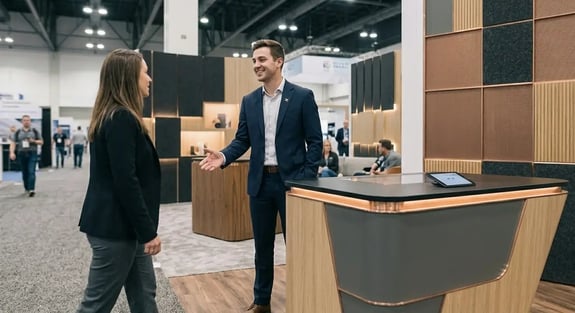
According to EXHIBITOR Magazine, you have 3-5 seconds to attract a passing attendee. Your staff's body language, positioning, and opening behavior determine whether the attendee enters the booth or walks past.
The First Three Seconds
Effective booth staff should:
- Stand visibly and remain approachable
- Avoid sitting behind tables or looking at phones
- Position themselves near booth entry points
- Make natural eye contact with passersby
A simple greeting such as “Welcome, what brings you to the show?” consistently outperforms scripted pitches.
For more on visual design, read our post on graphics that turn aisle traffic into engagement.
Engagement Beyond the Greeting
After the initial greeting, conversations should move into discovery within about 15 to 20 seconds.
Freeman Trends research shows 73% of Millennials and Gen Z prioritize experience quality over product demos.
CEIR data shows attendees spend an average of 7.5 hours on the exhibit floor across a multi-day show, competing with fatigue and information overload. Making your interaction feel easy and valuable is a significant competitive advantage.
Leveraging Booth Design for Engagement
Train staff to use the booth environment intentionally. Guide attendees to interactive elements, demonstration stations, or meeting areas based on their interests. Our guide on the psychology of engagement in experiential booths explains how physical design elements influence trust.
| Engagement Behavior | Impact on Lead Quality | Frequency Among Exhibitors |
|---|---|---|
| Opening with a diagnostic question | High (consultative, personalized) | ~25% of booth staff |
| Immediate product pitch | Low (generic, repels buyers) | ~50% of booth staff |
| Passive waiting for attendees to approach | Very Low (missed opportunities) | ~20% of booth staff |
| Structured lead qualification with scoring | Very High (actionable, prioritized) | ~15% of booth staff |
| Post-conversation lead capture and notes | High (enables effective follow-up) | ~35% of booth staff |
How Do You Qualify Leads Effectively on the Show Floor?
Trade show lead qualification is the process of determining which attendees represent genuine sales opportunities and categorizing them by urgency, authority, and fit.
Without a structured system, every badge scan looks identical. Sales teams return home with hundreds of contacts but little context.
CEIR research shows exhibitors using structured qualification methods convert 31 to 54% of conversations into qualified leads.
Build a Simple Qualification Framework
Create a rubric using three to five criteria, such as:
- Decision-making authority
- Budget alignment
- Implementation timeline
- Current solution or vendor
- Level of interest
Staff should integrate qualification questions naturally into conversation.
Use Technology to Capture Context
Badge scanners capture contact details but rarely capture context.
Equip staff with a lead capture app that allows staff to record:
- Lead score
- Conversation notes
- Key challenges discussed
- Agreed next steps
Thirty seconds of notes after each conversation saves hours of guesswork during follow-up.
Categorize Leads for Tiered Follow-Up
Categorize leads into three tiers:
- Hot leads
Immediate opportunity with decision authority. - Warm leads
Genuine interest, but longer timeline. - Informational leads
Early-stage research with no immediate project.
This tiering ensures your sales team invests follow-up energy where it produces the fastest returns. Our seven-step lead follow-up strategy provides a complete playbook for each tier.
How Does Real-Time Coaching Improve Performance?
Real-time coaching means observing staff interactions during the show and providing specific, actionable feedback between conversations.
Live interactions often reveal behaviors that training sessions miss, such as staff clustering together, spending too much time with unqualified visitors, or forgetting to record lead notes.
Designate a Floor Captain
Assign one senior team member as the floor captain whose primary role is observation and coaching, not personal lead generation.
Their role is not lead generation but performance oversight. Between conversations, they can provide short, actionable feedback that improves engagement throughout the day.
Run Micro-Debriefs Throughout the Day
Schedule 10-minute team huddles at natural break points.
Share what is working, address challenges, and adjust tactics based on traffic patterns. A team that adapts in real time outperforms one executing a rigid playbook. For more on environment, read about designing for wellness and calm engagement.
What Makes a Post-Show Follow-Up Strategy Convert?
Post-show follow-up is where trade show ROI is captured or lost.
CEIR reports it takes only 1.3 follow-up calls to close a trade show lead compared to 4-5 for cold leads. That advantage evaporates with every day of delay, yet only 20-30% of exhibitors follow up within 48 hours.
Start Follow-Up Before You Leave the Show
Hot leads should receive a personalized email within 24 hours.
The message should reference the specific conversation, acknowledge the attendee’s challenge, and propose a next step, such as a meeting or demo.
Generic "thanks for visiting" messages signal that the conversation was not meaningful. The seven-step follow-up strategy provides templates and timing for each lead tier.
Assign Follow-Up Ownership Before the Show
Many companies delay follow-up because responsibilities are unclear.
Define ownership before the show begins:
- Hot leads assigned to the salesperson who had the conversation
- Warm leads entered into nurture campaigns
- Informational leads added to educational content sequences
Close the Loop With ROI Measurement
Track every lead from capture through the pipeline to closed revenue.
This data reveals which shows, staff members, and engagement approaches produce the best results. Our guide on measuring experiential marketing ROI and our post on return on experience as a metric provide frameworks for this analysis.
How Do You Measure Booth Staff Performance?
Measuring staff performance transforms subjective impressions into objective data. Without measurement, you cannot identify top performers, coach underperformers, or make evidence-based staffing decisions for future shows.
Key Staff Performance Metrics
- Leads captured per staff member per hour: Your core productivity metric, revealing who engages actively.
- Lead quality score distribution: Fifty low-quality leads underperform twenty high-quality opportunities.
- Conversion rate from lead to booked meeting: Connects on-floor performance to pipeline impact.
- Average conversation length: Too short suggests insufficient qualification; too long suggests poor time management.
- Follow-up completion rate: Measures whether staff fulfill post-show commitments.
Post-Show Performance Reviews
Conduct individual reviews within one week of each show.
Celebrate successes, identify areas for development, and share anonymized data with the full team. These insights should feed back into exhibit strategy -- when you understand how staff use the space, you design future exhibits to support their most effective behaviors. Our article on strategic design principles for exhibits explores this connection.
"The best trade show programs treat staff training with the same rigor as exhibit design. Your booth is the stage. Your people are the performance. And your audience has buying authority." -- The team at Exhibit Options
Frequently Asked Questions
How far in advance should trade show staff training begin?
Start formal training at least four weeks before the show. The first session covers goals, messaging, and qualification criteria. The second session, two weeks out, focuses on role-play. A final briefing the day before reinforces key points. This cadence builds competence without overwhelming schedules.
How many staff members should we have in the booth?
A common formula is one trained staff member per 50 square feet of open engagement space, plus additional staff for meetings and demos. Overstaffing crowds the booth; understaffing causes missed opportunities. Plan shift rotations to maintain energy throughout the day.
What should staff do when the booth is slow?
Use slow periods for micro-debriefs, reviewing lead notes, and sending follow-up messages to hot leads. Staff should never cluster in groups, eat in the booth, or use phones visibly. One or two staff members should remain positioned at the perimeter, approachable and alert.
How do you handle staff who resist training?
Resistance usually stems from experienced salespeople who believe trade shows need no special approach. Share the data: the 3-5 second engagement window, the 81% buyer authority statistic, and the cost-per-lead advantage. Frame training as a specialized trade show performance technique, not basic sales skills.
What role does booth design play in staff effectiveness?
Booth design directly enables or constrains staff performance. Open entry points increase traffic, conversation zones allow private dialogue, and interactive stations create engagement opportunities. A cluttered layout forces staff to work against the environment. Always involve your exhibit partner in staffing discussions.
Conclusion: Your People Are Your Highest-ROI Investment
Every dollar you spend on your exhibit, floor space, graphics, and technology is amplified or wasted by the people in your booth.
Trade show staff training is the highest-ROI investment in your entire exhibit program. When your team arrives with clear goals, a consultant mindset, structured qualification methods, and a disciplined follow-up plan, the math works dramatically in your favor: $811 to close a lead, 1.3 calls to get there, and a floor full of attendees with buying authority.
The most successful exhibitors treat staff training as an ongoing discipline. They measure performance, coach in real time, and refine their approach show after show. Pair that trained team with a strategically designed exhibit, and you create a presence that converts traffic into revenue.
Ready to align your exhibit design with a winning booth strategy? Exhibit Options designs and fabricates exhibits engineered for staff performance, from open engagement zones to private meeting areas and demonstration stations. As a veteran and woman-owned full-service exhibit partner since 2005, we help brands build experiences where great people and great design work together. Contact us today to start planning your next show.

COMMENTS