
Table of Contents
- What Types of Pop-Up and Mobile Activations Work Best?
- How Does Trade Show Exhibit Expertise Translate to Pop-Ups?
- What Planning Considerations Differ from Trade Shows?
- How Do You Integrate Pop-Ups into Your Trade Show Program?
- How Do You Measure Pop-Up Activation Success?
- Frequently Asked Questions
The pop-up brand activation has become one of the fastest-growing channels in experiential marketing. According to Grand View Research, the experiential marketing market is projected to reach $195 billion by 2030, driven largely by brands bringing immersive experiences directly to consumers outside the convention center. If your exhibit program only lives on the trade show floor, you are leaving engagement and revenue on the table. A strong year-round exhibit strategy now includes pop-ups, mobile tours, and guerrilla activations that keep your brand visible 365 days a year.
What Are Pop-Up Activations and Why Are They Growing?
A pop-up brand activation is a temporary, immersive branded environment deployed outside a traditional trade show venue to engage consumers where they live, work, and socialize. Growth is accelerating because audiences crave real-world brand interaction beyond what digital channels deliver.
The experiential landscape now stretches far beyond exhibit halls. Brands deploy mobile brand experiences through touring vehicles, build brand houses at cultural events, stage guerrilla activations on city sidewalks, and embed interactive lounges inside music festivals. Each format shares DNA with trade show exhibits: a controlled, branded space designed to drive emotional connection. The difference is that pop-ups bring the experience to the audience.
The data is compelling. Research from EventTrack shows that 91% of consumers feel more positive about a brand after a live experience, and 85% are more likely to purchase afterward. A Harris Poll study found that 78% of Millennials prefer spending on experiences over material goods. Understanding the psychology of engagement behind these numbers explains why pop-ups deliver outsized returns.
For brands already investing in trade shows, pop-ups expand existing capabilities into new audiences and markets. Read our guide on what is experiential marketing for more on these foundations.
What Types of Pop-Up and Mobile Activations Work Best?
The best activation type depends on your audience, objectives, and logistics. Here are five proven formats, each suited to different goals. Understanding the distinction between brand activation vs experiential marketing can help clarify which approach fits.
Retail Pop-Ups
Temporary branded storefronts in high-traffic retail corridors or malls.
Best use case: product launches, seasonal campaigns, or direct-to-consumer testing in new markets.
Mobile Tour Vehicles and Trailers
Custom trucks or trailers traveling a multi-city route.
Best use case: national sampling campaigns, campus tours, or B2B roadshows. The mobile format eliminates venue rental and creates consistency across stops.
Brand Experience Lounges
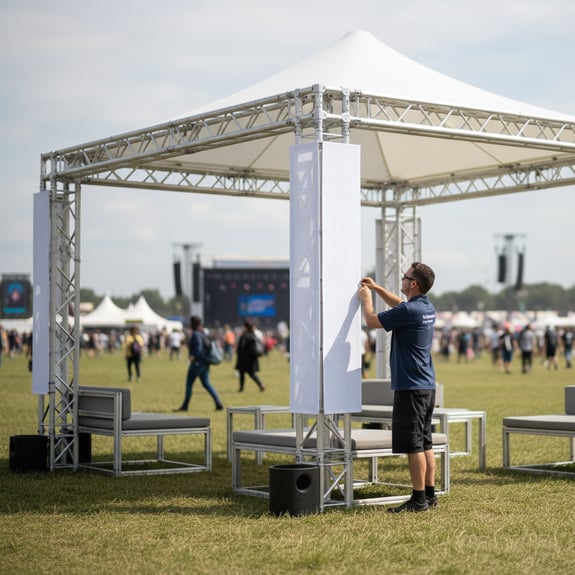
Branded environments within festivals or conferences featuring hospitality, demos, and interactive technology.
Best use case: building affinity with lifestyle audiences where your demographic gathers organically. Incorporating multisensory design elevates these beyond simple sponsorship signage.
Product Launch Events
High-impact activations designed around a specific product reveal, combining media previews, influencer access, and public experiences.
Best use case: generating earned media around a major debut.
Guerrilla and Street-Level Activations
Unexpected brand moments in public spaces like parks or transit hubs.
Best use case: driving organic social sharing. EventTrack data shows each attendee shares their experience with an average of 17 people. Learn more in our article on creating viral experiences.
Pop-Up Activation Types at a Glance
| Activation Type | Typical Duration | Audience Reach | Primary Objective | Complexity |
|---|---|---|---|---|
| Retail Pop-Up | 2-12 weeks | Local / Regional | Sales & Market Testing | Medium |
| Mobile Tour | 4-16 weeks | National / Multi-City | Sampling & Awareness | High |
| Festival / Conference Lounge | 2-5 days | Event-Specific | Affinity & Engagement | Medium |
| Product Launch Event | 1-5 days | Targeted / Media | Earned Media & Buzz | High |
| Guerrilla / Street-Level | 1-3 days | Hyper-Local | Social Sharing & WOM | Low-Medium |
How Does Trade Show Exhibit Expertise Translate to Pop-Ups?
The skills required to build pop-up activations are nearly identical to trade show exhibit competencies. A team that excels at branded environments for the show floor brings a significant head start to pop-up work.
Spatial design is fundamental to both formats: understanding traffic flow through a finite footprint, where sight lines draw attention, and how to create zones for different engagement levels. A 20-by-20 trade show island and a 400-square-foot retail pop-up present remarkably similar challenges.
Fabrication is another direct overlap. Custom structures, dimensional signage, and branded fixtures all require precision manufacturing. At Exhibit Options, our in-house fabrication capabilities, including 6-axis CNC machining at our Las Vegas and Cerritos facilities, produce pop-up components with the same quality we bring to exhibit builds.
Logistics and logistics planning complete the picture. Trade show teams already manage freight, storage, and install and dismantle crews under tight timelines. Pop-ups add variables like multi-city routing, but the project management framework stays the same.
"Every pop-up activation we build draws on the same spatial design, engineering, and logistics expertise we use on the trade show floor. The venue changes, but the craft does not. Our clients get a single team that understands immersive branded environments whether the experience lives in a convention center, a city park, or a custom trailer crossing the country."
— The team at Exhibit Options
What Planning Considerations Differ from Trade Shows?
While creative and fabrication skills transfer directly, operational planning for a pop-up brand activation introduces factors that convention venues handle automatically. Addressing these early prevents costly surprises.
Permitting and zoning top the list. Convention centers come with pre-established permits, but a pop-up on public or private land requires municipal permits, fire marshal approvals, and sometimes health department clearances. Some municipalities require applications 60 to 90 days in advance. Organizations like the EDPA provide resources for navigating these requirements.
Site selection goes beyond foot traffic counts. Evaluate surface conditions for anchoring, proximity to power, freight access, and sight-line visibility from pedestrian corridors. A site visit is non-negotiable for any substantial activation.
Weather creates risk that indoor shows never face. Structural engineering must account for wind loads, rain, and temperature extremes. Contingency plans for severe weather should be part of every outdoor activation plan.
Audience dynamics also shift. Trade show attendees are pre-qualified professionals. Pop-up audiences are general public who may encounter your activation by chance, meaning engagement scripts need to be accessible and ADA compliance must meet public accommodation standards.
Finally, power and connectivity cannot be assumed. Generators, battery packs, and cellular-based connectivity solutions become standard pop-up budget line items.
How Do You Integrate Pop-Ups into Your Trade Show Program?
The greatest value of pop-up activations emerges when they are integrated into your broader exhibit strategy rather than treated as standalone events. A coordinated approach creates year-round momentum and maximizes asset ROI.
One proven approach: use pop-ups to warm up target markets before a major trade show. A mobile activation four to six weeks before your conference builds awareness, generates leads for your booth team, and creates social content that drives pre-show traffic. After the show, a follow-up pop-up reinforces your message and captures prospects who did not attend. This aligns with strategies we cover in extending engagement beyond the event.
Repurposing exhibit assets is one of the most cost-effective tactics. Modular components, graphic panels, interactive technology, and furniture can be redeployed from a trade show booth into a pop-up configuration. This stretches your fabrication investment across multiple touchpoints.
Content creation bridges both formats. EventTrack reports that 98% of consumers create digital or social content at branded events. When planned intentionally, trade shows and pop-ups feed a unified content pipeline for social media, email, and paid advertising year-round.
How Do You Measure Pop-Up Activation Success?
Measuring pop-up ROI requires defined KPIs established before launch. Pop-ups often enable richer data collection than trade shows because you control the entire environment and audience flow. For a complete framework, see our guide on measuring experiential ROI.
Foot traffic and dwell time form the foundation. Sensors, counters, or registration systems track how many people entered and how long they stayed. Longer dwell times correlate with deeper engagement and higher conversion.
Social impressions and user-generated content matter for amplification. Track branded hashtag usage, geo-tagged posts, and video views. EventTrack data shows each attendee shares their experience with an average of 17 people, so even modest activations generate substantial earned reach.
Lead capture remains essential for B2B activations: digital forms, QR code interactions, and post-experience surveys. For consumer activations, track email opt-ins, app downloads, and loyalty sign-ups.
Sales lift is measured through point-of-sale data, promo code redemptions, or post-activation purchase tracking. Earned media value from press and influencer mentions adds another quantifiable layer.
Finally, benchmark cost-per-engagement against your trade show program. Many brands discover pop-ups deliver lower cost per interaction by eliminating booth space fees and show services.
Frequently Asked Questions
How much does a pop-up brand activation cost compared to a trade show exhibit?
Costs vary by scale and location, but many pop-ups cost less per engagement than trade shows because they eliminate booth rental and show service fees. Well-planned activations leverage existing exhibit assets to reduce fabrication costs. Budgets typically range from $15,000 for sampling activations to $250,000 or more for multi-city mobile tours.
How far in advance should we start planning a pop-up activation?
Plan at least three to four months ahead for a single-location pop-up and six to nine months for a multi-city tour. Permitting can require 60 to 90 days, and custom fabrication, site selection, and staffing all have long lead times. Starting early also gives you leverage in negotiating venue partnerships.
Can we reuse our existing trade show exhibit for a pop-up?
Yes, and it is one of the most effective ways to maximize your exhibit investment. Modular systems, graphic panels, interactive screens, and branded furniture can all be reconfigured for pop-up environments. Your exhibit partner can assess which components transfer directly and which need adaptation for outdoor conditions or non-standard footprints.
What permits do we need for a pop-up activation in a public space?
Requirements vary by jurisdiction but typically include a temporary event permit, fire department approval, certificates of insurance, and sometimes noise or health department clearances. Private property activations require a lease or license agreement with the property owner. Always verify ADA compliance requirements for public-facing activations.
Bring Your Brand to New Audiences with Pop-Up Activations
Pop-up activations and mobile brand experiences extend your reach, deepen engagement, and create year-round momentum that a three-day trade show alone cannot achieve. The market is heading toward $195 billion because consumers want tangible brand interactions, and smart marketers are meeting them where they are.
At Exhibit Options, we bring two decades of exhibit design, in-house fabrication, and experiential logistics expertise to every activation we build. As a veteran-owned, woman-owned agency with fabrication facilities in Las Vegas and Cerritos, we offer end-to-end capabilities: spatial design, 6-axis CNC fabrication, branded environment construction, multi-city logistics, and seasoned install and dismantle crews. Whether you are planning your first retail pop-up or scaling a national mobile tour, we build experiences that perform.
Ready to take your exhibit on the road? Contact Exhibit Options to start planning your next pop-up brand activation.

COMMENTS