
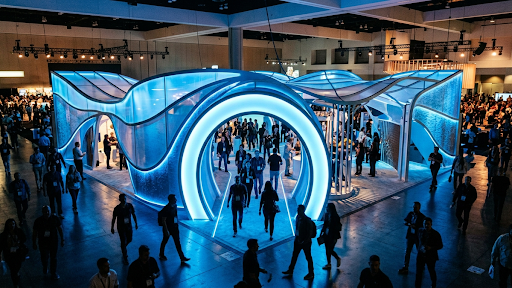
A brand activation is a live, interactive experience that brings a brand to life and prompts an audience to engage with it directly. The goal is participation, not passive exposure. Attendees touch, play, sample, or step inside the brand instead of just watching an ad. Brand activations run at trade shows, in retail, on the street, and online, and the best ones turn a product into something people remember.
Key Takeaways
- A brand activation is a live, interactive experience designed to make an audience participate with a brand, not just view it.
- The main types are experiential installations, pop-up and mobile activations, product launches and theaters, sponsorships and lounges, and digital or AR/VR experiences.
- Brand activation success is measured with both traditional ROI (leads, qualified conversations, pipeline) and Return on Experience (ROX): dwell time, earned impressions, and brand lift.
- An exhibit house designs and builds activations as physical environments, so the experience visitors approve in 3D is what gets fabricated and installed.
What is a brand activation?
A brand activation is any campaign or experience built to spark direct interaction between an audience and a brand. The word "activation" is the point. It activates interest, turning awareness into a moment a person actively takes part in. Where a traditional ad asks you to watch, a brand activation invites you to do something, then connects that action to the brand.
Activations are inherently experiential. They use space, design, sound, technology, and human interaction to create a scene a visitor walks into rather than scrolls past. That's why brand activation marketing has grown alongside experiential marketing, and why the strongest activations live in the physical world, where a brand can engineer every sense at once. For the wider strategic picture beyond the show floor, see our pillar on brand activations and experiential marketing.
What are the types of brand activations?
Brand activations take several forms, and most campaigns blend more than one. These are the formats an exhibit house designs and builds most often.
- Experiential installations. Immersive, interactive environments built around a single brand story, often the centerpiece of a trade show island booth. Visitors explore, play, and engage hands-on.
- Pop-up and mobile activations. Temporary branded spaces that appear in high-traffic locations or travel by truck and trailer from city to city. See our guide to pop-up activations and mobile brand experiences.
- Product launches and theaters. Staged reveals and live demo zones that gather a crowd, show a product in action, and create a shareable moment.
- Sponsorships and brand lounges. Hospitality environments at conferences and major shows where a brand hosts, networks, and builds relationships in a designed space.
- Digital and AR/VR experiences. Interactive touchscreens, gamification, and augmented or virtual reality that let visitors test a product or step into a brand world that physical space alone can't show.
What are some brand activation examples?
Brand activation examples span every industry, and the pattern is always the same: turn the product benefit into something the audience can experience firsthand.
A beverage brand might run a sampling pop-up in a busy plaza, pairing free tastings with a photo moment that travels on social. A technology company might build a product-launch theater that stages live demos every half hour. An automotive brand might create an AR ride-along that lets visitors "drive" a new model through a virtual landscape from the show floor. A consumer-goods company might host a sponsor lounge where buyers meet the team and try the line.
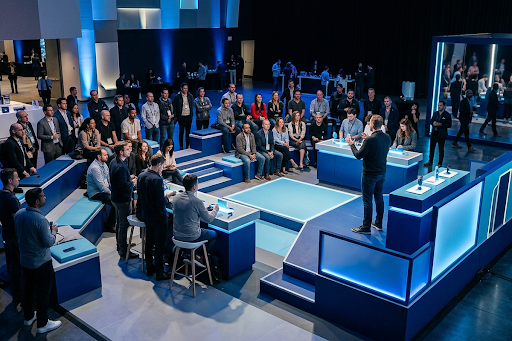
What connects these is design intent. Each one is engineered to make a specific audience stop, participate, and associate a feeling with the brand. The medium changes, but the job stays the same: convert attention into action. That same principle is the foundation of how experiential work builds trust, covered in our piece on the psychology of experiential marketing.
Brand activation vs. experiential marketing: what's the difference?
These terms overlap heavily and people use them interchangeably, but there's a useful distinction. Experiential marketing is the broad strategy of engaging audiences through live, immersive experiences; a brand activation is a specific campaign or moment within that strategy, with a defined goal and a start and end. Put simply, experiential marketing is the approach, and a brand activation is one execution of it. We break the full comparison down in brand activation vs. experiential marketing.
How do you measure brand activation ROI?
You measure brand activation ROI with two lenses: traditional ROI and Return on Experience. Traditional ROI tracks the hard outcomes you can tie to revenue, such as leads captured, qualified conversations held, demos booked, and pipeline created. A well-run activation should produce them.
Return on Experience, or ROX, captures the value a simple lead count misses: dwell time at the experience, social and earned media impressions, content captured and shared by attendees, and measurable brand lift in awareness or sentiment. A pop-up that generates a flood of organic social posts delivers real value even when its direct lead count is modest, and ROX is how you account for it.
The practical approach is to set both kinds of goals before the activation and instrument for them. Decide what a successful conversation looks like, how you'll log it, and which experience signals you'll track. The activations that pay off are designed around a measurable goal from the first sketch.
How does Exhibit Options build brand activations?
We design and build brand activations as physical environments, all under one roof. As a single-source exhibit house, we handle strategy, design, engineering, fabrication, graphics, technology integration, and installation in-house across our Cerritos and Las Vegas facilities. That means one team owns the activation from concept to the show floor, with no fragmented hand-offs.
Our From Render to Reality process keeps the experience faithful to the plan: what you approve in a 3D rendering is what we fabricate, and we stage it in our warehouse for sign-off before it ships. Whether you're planning an experiential installation, a pop-up, a product theater, or an interactive AR experience, we build it to a measurable goal. Explore what an experiential marketing agency can do when design and fabrication live in the same building.
Frequently Asked Questions
What's the difference between a brand activation and an event?
An event is a gathering with a time and place. A brand activation is a designed, interactive experience built to make a specific audience engage with a brand. An activation often happens at an event, such as a trade show, but its purpose is participation and a measurable outcome, not just attendance.
What is an experiential brand activation?
An experiential brand activation engages the senses and invites hands-on participation, immersing an audience in a brand rather than presenting it from a distance. It uses space, technology, sound, and human interaction to create a scene visitors step into. Most strong activations are experiential by design, because participation is what makes a brand moment memorable.
How much does a brand activation cost?
Cost depends on scale, complexity, technology, and how many shows or locations the activation runs. A focused pop-up sits at one end of the range, while a large island installation with AR, custom fabrication, and travel sits at the other. The best way to budget is a detailed proposal that lists every cost and service, so you can match the activation to your goals.
How do you measure brand activation success?
Measure success against goals you set in advance, using both traditional ROI and Return on Experience. Track hard outcomes such as leads, qualified conversations, and pipeline, alongside experience signals such as dwell time, earned and social impressions, and brand lift. Instrument the activation to capture these before it goes live, not afterward.
What types of companies use brand activations?
Brand activations work for any company that benefits from a person experiencing a product or message firsthand, from consumer goods and beverage to technology, automotive, healthcare, and B2B. First-time exhibitors and seasoned enterprise brands both use them. The deciding factor isn't industry, it's whether direct, hands-on engagement will move your audience further than a passive impression would.
Can a brand activation work at a trade show booth?
Yes. A trade show booth is one of the most effective homes for a brand activation, because it gathers a qualified audience in one place and gives you a designed space to engage them. Building an experiential installation, demo theater, or interactive zone into a booth turns floor space into a destination. Our custom trade show exhibits are built to do exactly that.
Ready to bring your brand to life?
Whether you're planning your first pop-up or a full island activation, we design, build, and install brand activations in-house across our Cerritos and Las Vegas facilities, with one team owning the experience from the first sketch to the show floor. Tell us your goals, your audience, and your show calendar, and we'll recommend an approach built to a measurable outcome. Start the planning conversation with our experiential marketing team and let's build something worth experiencing.
By Rena Patton — Co-founder of Exhibit Options, a single-source exhibit house since 2005, designing, engineering, fabricating, and installing custom trade show exhibits and rentals in-house from its Cerritos, CA and Las Vegas, NV facilities. Veteran-owned and woman-owned.

COMMENTS