
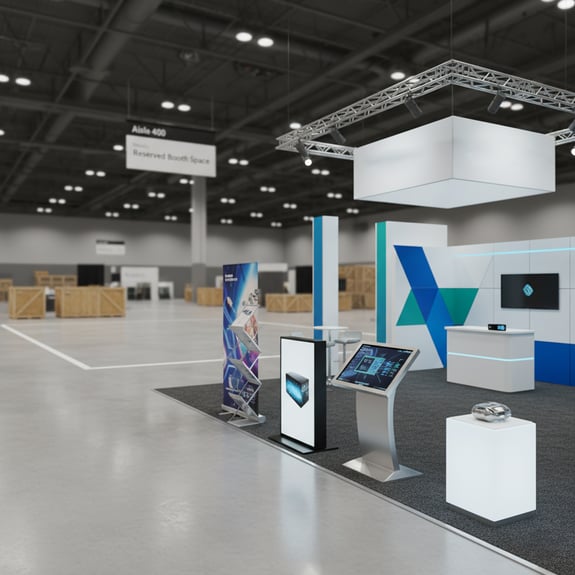
If you’ve ever found yourself using booth, exhibit, and display interchangeably, you’re not alone. Even seasoned event marketers sometimes blur these lines. But understanding the difference isn’t just about terminology; it’s about how you plan, design, and measure the success of your trade show presence.
It really wasn’t that long ago that setting up for a trade show felt a bit simpler. You booked your space, set up a few banners, and hoped for the best. Today, trade show marketing has evolved into a sophisticated form of experiential design, where every square foot, every light, and every message is part of a larger story. And that story starts by understanding what each term truly means.
Booth: The Location
A booth refers to the physical space you secure on the trade show floor. When you reserve a 10x20, 20x30, or island configuration, you’re claiming the real estate where your brand will come to life. Think of it as your plot of land.
While it might seem like a simple logistical detail, booth selection is actually a strategic decision. The size, shape, and location have a direct impact on visibility, visitor flow, and the potential for engagement. Corner booths invite traffic from multiple directions. Inline booths offer cost efficiency but require careful layout to stand out. Island booths, though more expensive, deliver 360-degree exposure and creative freedom.
Your booth is where it begins, but it’s what you build within it that defines your success.
Exhibit: The Experience
An exhibit is the complete environment your audience steps into. It’s the architecture, storytelling, and sensory experience that transform an empty booth space into a brand destination. Every wall, display, digital element, and interaction works together to form one cohesive message: who your brand is and why it matters.
Exhibit design is about more than aesthetic appeal. It’s experiential marketing in its purest form, where spatial design and brand psychology intersect. A well-crafted exhibit guides visitor flow naturally, creates intuitive points of interaction, and encourages meaningful conversations.
For marketing and event managers under pressure to prove ROI, this is where the difference is felt most. A booth alone is static. An exhibit transforms that space into an active stage for your brand, capturing, engaging, and converting.
Display: The Supporting Elements
A display is any individual component that lives within your exhibit, such as a banner stand, product pedestal, pop-up backdrop, LED screen, or interactive kiosk. Displays are the storytelling tools that highlight products, visualize messages, and invite participation.
Your displays are the chapters that make up your exhibit’s story. Each one should serve a clear purpose, whether it’s attracting attention from the aisle, demonstrating a product benefit, or supporting a hands-on experience.
Too many displays can clutter your message. Too few can leave your space feeling empty. The right balance is strategic, and it’s where a full-service exhibit partner brings real value.
Why This Distinction Matters
At first glance, these terms might feel like semantics. But understanding the hierarchy between booth, exhibit, and display helps you make smarter investments.
When you view your booth as a location, your exhibit as the brand experience, and your displays as the storytelling tools, you start planning holistically instead of building something to fill space. This clarity affects everything from budgeting and logistics to creative concepting and ROI measurement.
It’s also essential for communication. When your internal teams and external partners share the same language, your planning process becomes smoother, your deliverables clearer, and your results more impactful.
From Space to Story: Where Experiential Design Comes In
As an experiential marketing agency and exhibit builder, Exhibit Options approaches every trade show program as a strategic brand environment, not a set of walls. Our process begins by understanding your goals, audience, and brand identity, then translating that insight into an exhibit that feels immersive, purposeful, and results-driven.
Whether it’s a custom double-deck exhibit that commands attention, a modular booth designed for flexibility, or a portable display system that supports regional events, every project is crafted with one question in mind:
How will this experience make your audience feel, and what will they remember afterward?
That’s the essence of experiential design. It’s what turns trade show exhibits into brand encounters that connect emotionally and deliver measurable value long after the show ends.
Common Misconceptions
“We just need a bigger booth.”
Not necessarily. A larger footprint doesn’t automatically translate into greater impact. Strategy, storytelling, and smart design drive engagement, not square footage.
“A display is enough for smaller shows.”
Sometimes it is, but only when it’s intentional. Even a simple banner or pop-up backdrop should be thoughtfully designed to reinforce your brand and align with your broader marketing strategy.
“Custom means complicated.”
With the right exhibit partner, it doesn’t have to be. A true experiential marketing agency streamlines the process from creative concept to fabrication, handling logistics, compliance, and installation so you can focus on results, not details.
Creating Experiences, Not Just Exhibits
The trade show floor is no longer a space for static structures; it’s a stage for storytelling. Each brand’s goal should be to create an environment that draws people in, sparks connection, and leaves a lasting impression.
At Exhibit Options, we believe the difference between a booth, an exhibit, and a display isn’t just a matter of vocabulary; it’s a matter of vision. When you treat your trade show presence as a brand experience rather than a checklist, you move from showing up to truly standing out.
Ready to transform your next trade show presence into an experience that connects?Let’s start with a conversation about your goals, your story, and how we can bring them to life.
Contact Exhibit Options to begin planning your next event.

COMMENTS