
Choosing a trade show exhibit builder comes down to one question: how much of your booth does this company actually make?
Design, engineering, fabrication, graphics, logistics, and installation are six separate jobs. The number a partner performs in-house determines your cost, your timeline, and who answers when something needs to change on the show floor. Most exhibitors work through that decision under real pressure, with a fixed show date, a budget under scrutiny, and stakeholders expecting measurable results. The questions below are built to make the comparison faster.
Two business models look identical on paper
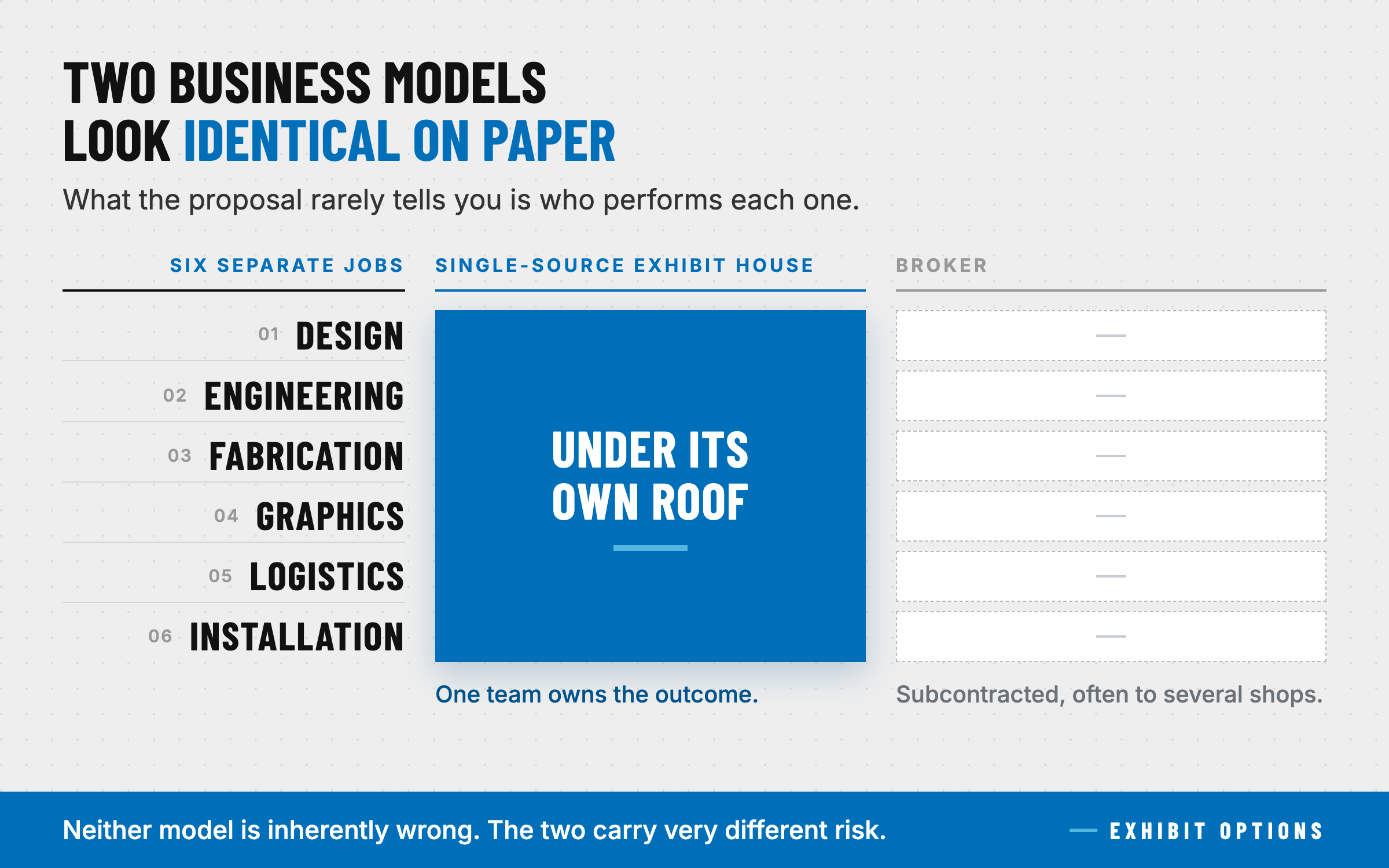
Almost every proposal you receive will describe design, fabrication, graphics, and installation. What the proposal rarely tells you is who performs each one.
A single-source exhibit house designs, engineers, and builds under its own roof, prints its own graphics, and manages the show. One team owns the outcome. A broker wins the account and then subcontracts the work, often to several shops. The rendering can be beautiful either way. The difference shows up when a graphic panel arrives with the wrong finish four days before move-in and nobody in the room can fix it themselves.
Neither model is inherently wrong. What matters is knowing which one you are buying, because the two carry very different risk.
The eight questions that reveal the answer
Ask these on the first call. The answers will separate your shortlist faster than any capabilities deck.
1. Which parts of this project happen in your own facility? Ask for specifics: design, engineering, CNC fabrication, metalwork, grand-format printing, project management, installation and dismantle. A partner with real in-house capability will name them without hesitating.
2. Where is your shop, and can I visit it? Square footage and location are checkable facts. A shop near your show market cuts shipping and drayage, which are real line items on your invoice, not rounding errors.
3. Who is my point of contact from concept through dismantle? The right answer is a person, not a department. Handoffs between a salesperson, a designer, and a show manager are where details get lost.
4. Will I see the exhibit assembled before it ships? Pre-show staging means the booth is fully built in the warehouse and you sign off on the real thing rather than a rendering. It is the most reliable way to remove surprises from move-in day.
5. What exactly is in the proposal, and what is not? A complete proposal itemizes design, fabrication, graphics, crating, shipping, drayage estimate, installation and dismantle labor, storage, and refurbishment. The lowest quote is usually the one that left three of those out.
6. Can I reconfigure this exhibit for other shows? If you exhibit at a 20x20 and a 10x20 in the same year, engineering for reconfiguration up front costs far less than building twice. Ask what your footprint options are before design starts.
7. Where will the exhibit live between shows, and what does that cost? Asset management, storage, and refurbishment are ongoing costs of ownership. They belong in the conversation before you sign, not in an invoice next March.
8. Can you show me work at my booth size, in my industry? Ask for projects at comparable footprints. A portfolio of double-deck islands tells you very little about how a company executes a 10x20.
What a strong proposal actually contains
Comparing two proposals fairly is hard when they are formatted differently. Normalize them first.
- Total delivered cost, not build cost. Add crating, freight, drayage estimate, and labor to every quote before comparing.
- A named timeline with design approval, engineering, fabrication, staging, and ship dates.
- Graphics production identified as in-house or outsourced, with file specs and deadlines stated.
- Labor broken out by installation and dismantle, with an estimate of hours and crew.
- Ownership terms, meaning what you own at the end, what is rented, and what happens to it after the show.
If a line item is missing from one proposal and present in another, that is not a price difference. It is a scope difference, and it will find you later.
Buying versus renting changes the question
The eight questions above apply whether you buy or rent, but the weighting shifts. If you exhibit once or twice a year, or you are testing a new market, rental exhibits let you get a custom look without owning an asset. If you are on the show floor four or more times a year, ownership usually wins on total cost. We ran the numbers in detail in renting versus buying a trade show booth, and the footprint decision is covered in how to choose a trade show booth size.
How Exhibit Options answers these questions
We built Exhibit Options around the single-source model because fragmented accountability is the problem we kept seeing on show floors. Design, engineering, CNC fabrication, grand-format printing, project management, and installation all happen in our own facilities: 37,000 square feet in Cerritos, California, and 22,000 square feet in Las Vegas. Two West Coast shops mean shorter hauls and lower drayage into the venues our clients exhibit at most.
Every exhibit is staged in our warehouse for your sign-off before it ships, which is the promise behind From Render to Reality: what you approve in the 3D rendering is what gets built. Our proposals itemize every cost and service, so nothing surfaces late. We have been doing this since 2005, and we are veteran-owned and woman-owned.
If you are evaluating partners for a fully custom build, our custom trade show exhibits page walks through the full process from first sketch to final installation.
Frequently asked questions
What is the difference between an exhibit house and a broker?
An exhibit house designs and fabricates in its own facility. A broker wins the account and subcontracts the work, often across several shops. Both can deliver a good booth. Only one has direct control when something needs to change quickly.
How far in advance should I choose an exhibit builder?
For a fully custom build, start six to nine months before the show. Design and engineering approvals, fabrication, graphics production, and pre-show staging each need real time. Rentals and modular programs can move considerably faster.
What questions should I ask before signing a proposal?
Ask what happens in-house, who your single point of contact is, whether you will see the booth staged before it ships, and what the total delivered cost includes: crating, freight, drayage, and labor, not just the build.
Does a builder’s location actually matter?
Yes. Shipping and drayage scale with distance and weight, and they are billed on every show. A shop near your primary show market reduces both and shortens the turnaround when a last-minute change is needed.
Why do exhibit quotes vary so much for the same booth?
Usually because they cover different scopes. One quote includes crating, freight, drayage, and labor while another covers fabrication only. Normalize every proposal to total delivered cost before you compare them.
Can one partner handle multiple shows in a year?
Yes, and it is generally the better arrangement. A single partner holding your design files, your assets, and your show history can reconfigure the same exhibit across footprints instead of rebuilding for each show.
Explore Your Options for Your Next Show
Tell us what you are building and which shows you are working toward. Call 866.780.1555 or get in touch, and we will walk you through what a complete proposal for your footprint looks like. It starts as a planning conversation, not a quote.
About the author. Rena Patton is co-founder and owner of Exhibit Options, a veteran-owned and woman-owned single-source exhibit house founded in 2005, with design and fabrication facilities in Cerritos, California and Las Vegas, Nevada.

COMMENTS